



.jpg)
.jpg)


%20(1).webp)
.webp)
.webp)

.webp)



%20(1).jpg)



Definition and Components of a Business Presentation
Unpacking the Core: The What and Why of Business Presentations
Business presentations are pivotal in the corporate landscape, acting as a bridge between a company and its audience—be it clients, investors, or internal teams. This opening paragraph sets the stage for our exploration, highlighting the essence of a business presentation. It's not merely about presenting a company; it's about crafting a narrative that engages, informs, and compels action. Here, we delve into what makes up a business presentation, emphasizing its importance in achieving business objectives and how it fits into the broader context of corporate communication.
Building Blocks: Anatomy of an Effective Presentation
Diving deeper, we explore the structural components that constitute a business presentation. From the opening slide that sets the tone, through the compelling core where ideas and data intermingle, to the concluding call to action, every element plays a crucial role. This section breaks down the anatomy of a presentation, including the significance of a visually appealing design, the strategic use of visual representations like charts and graphs, and the art of balancing information density to maintain the attention spans of audience. The goal is to provide a comprehensive understanding of the components that, when combined, create a compelling business presentation.
From Theory to Practice: Stories of Impact
Here, we transition from the theoretical framework to the tangible impact of business presentations in the real world. By presenting examples from various industries, we illustrate how presenting a company effectively can pivot its market position, attract potential customers, or secure funding from potential investors. This narrative brings to life the power of a well-crafted presentation, showcasing real success stories and current trends that underline the importance of design, storytelling, and audience engagement.
Expert Insights and Quantitative Backing
In this part, we lean on expert opinions and quantitative data to underscore the value of professional presentation design. Highlighting insights from industry leaders like Aayush Jain of INK PPT, we discuss the undeniable impact of aesthetics and narrative in making a presentation not just seen but felt. This exploration is reinforced with statistics and research findings, validating the strategic importance of most presentations in business success and decision-making processes.
Vision for the Future: Evolving Presentation Landscapes
Concluding, we look forward to the evolving dynamics of business presentations, especially in the context of digital transformation and virtual engagement. This future outlook article is complemented by a YouTube video link that offers viewers a deeper dive into innovative presentation techniques and the emerging tools reshaping how we convey business narratives. This segment aims to leave readers with a sense of anticipation and readiness for the advancements in presentation strategies, encouraging them to think beyond traditional formats towards more interactive, engaging approaches.
[Explore Innovative Presentation Techniques]
Historical Evolution of Business Presentations
Business presentations have come a long way from the days of overhead projectors and flip charts. Initially, an organization's portrayal involved simple tools and a straightforward approach. Today, professional company presentation has transformed into a sophisticated process that leverages advanced technology like PowerPoint to deliver powerful messages.
Imagine the evolution of business presentations as a journey from the simplicity of a hand-drawn road map to the complexity of a GPS system. For instance, in the 1980s, a company presentation might have been limited to paper handouts and verbal explanations, while today, it involves dynamic PowerPoint slides, videos, and interactive elements.
Research indicates that the use of visual aids in presentations has increased retention rates by up to 65%, highlighting the shift towards more visually oriented communication strategies.
"In the early days, we relied on our words and basic slides to convey our ideas. Now, we use a rich tapestry of visuals, animations, and interactive elements to tell our story," reflects Aayush Jain on the evolution of presentation techniques.
Common Types of Business Presentations

There are several types of business presentations, each designed to fulfill specific objectives. From informational to persuasive, and decision-making presentations, the goal is always to present the company in the best light possible.
Consider the difference between a documentary and a feature film. Both tell stories, but while the documentary aims to inform and educate, the feature film seeks to entertain and perhaps persuade. Similarly, an informational presentation aims to educate the audience about the company profile, while a sales pitch seeks to persuade potential clients to invest.
Statistics show that over 70% of businesses consider presentation skills crucial for career success, underscoring the variety and importance of these presentations in the professional landscape.
"Each type of business presentation requires a unique approach to storytelling and design. Understanding your audience's needs and expectations is key to delivering a successful presentation," advises Aayush Jain.
Purposes and Objectives of Business Presentations

The primary purpose of an organizational presentation varies from presenting a company's achievements to potential investors, to educating new employees about company policies. Each presentation is designed with specific objectives in mind, such as persuading clients or facilitating decision-making processes.
The purpose of a business presentation can be compared to a compass in a ship's navigation. Just as a compass guides the ship towards its destination, the objectives of a presentation guide the content and delivery to achieve the desired outcome. An example of this is using a company presentation to secure new clients by effectively communicating the value proposition.
Data from LinkedIn shows that presentations with clear objectives are 50% more likely to achieve their desired outcomes, highlighting the importance of having a focused message.
"Setting clear objectives at the inception of the presentation design process ensures that every separate slide, every visual element, and every word spoken is aligned with the goal of showcasing the company in the most effective manner," says Aayush Jain.
Understanding the purposes behind business presentations paves the way for exploring the role they play in decision-making, further demonstrating their importance in the corporate world.
The Role of Business Presentations in Decision-Making

Business presentations are pivotal in the decision-making process, providing a structured opportunity for presenting complex information and recommendations. They serve as a crucial touchpoint, influencing the opinions and actions of stakeholders, from internal team members to external partners and clients.
Imagine the idea of a company presentation as a compass guiding a ship through the treacherous waters of corporate decision-making. Just as a captain relies on a compass to navigate, so do leaders rely on presentations to guide their decisions.
For instance, a well-executed presentation that showcases a comprehensive market analysis and competitive advantages can significantly influence the strategic direction of a company.
Research from the Decision Management Association highlights that decks that effectively present relevant data and analysis can improve decision-making speed and accuracy by up to 40%. A study by the International Business Communication Council found that decision-makers cite clarity, conciseness, and relevance as the top three factors that make presentations impactful in their decision-making process. These insights underscore the importance of strategic focus and data-driven content in business decks.
Key Elements of a Successful Business Presentation in showcasing a company
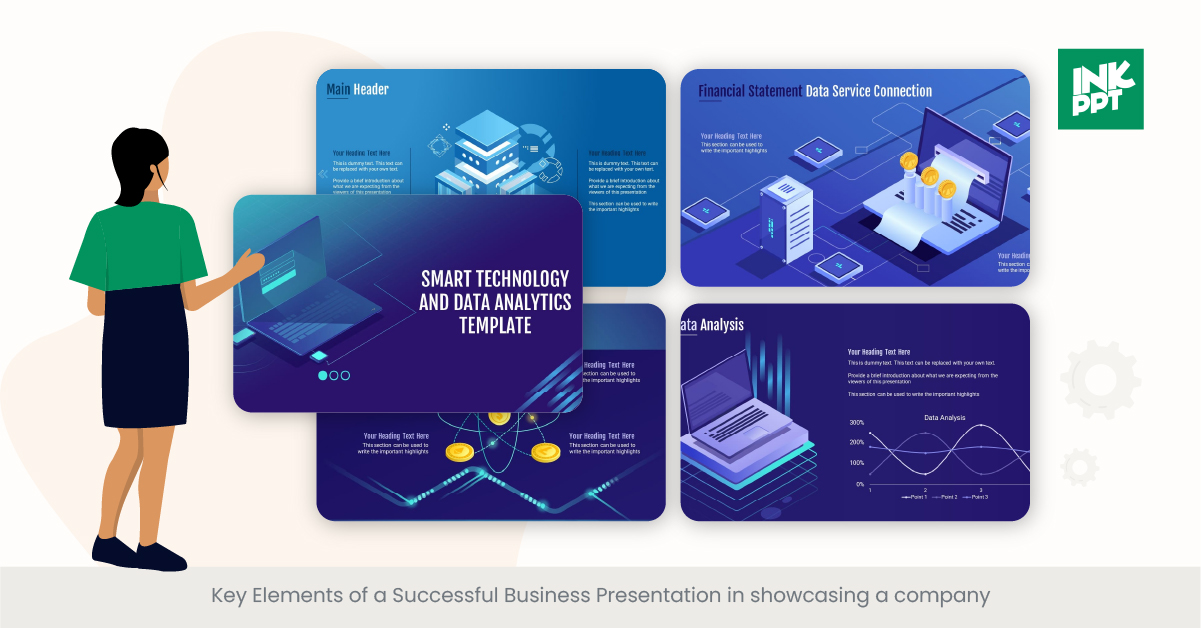
A successful business presentation hinges on several key elements: clear objectives, audience understanding, powerful storytelling, effective visual aids, and confident delivery. These components work in concert to engage the audience, convey the message effectively, and achieve the presentation's intended outcomes.
For example, incorporating visual aids such as bar graphs and slides can help illustrate complex ideas, much like how a vivid solo can highlight a particular emotion in a musical piece.
A study by the Presentation Institute of America found that presentation decks incorporating visual aids are 67% more effective at maintaining the attention. Additionally, Gallup research indicates that presentations that include storytelling elements are twice as likely to result in a positive outcome.
These findings highlight the critical role of integrating multiple elements to craft a driving and successful presentation.
Company Presentation vs. Public Speech: Understanding the Distinctions

While often intertwined, company presentations and public speech serve distinct purposes and require different skill sets. A business presentation is typically more focused on delivering specific information or persuading an audience regarding an organization-related topic, utilizing visuals and structured content.
Public speech, on the other hand, might focus more broadly on inspiring, informing, or entertaining an audience, often without the support of graphics.
Imagine a business presentation as a guided tour through a museum, where the guide (presenter) points out and explains various artifacts (points of discussion) with the help of visual cues and structured narrative.
Public speech, in contrast, is like a storyteller weaving tales under the moonlight, where the power of voice and story alone captures the audience's imagination. For instance, while showcasing an organization to investors, the focus is on persuading through data and strategic insights, distinct from the broader motivational approach of speaking publicly.
According to a study by the Public Speaking Association, 80% of professionals believe that presentation skills are crucial to achieving business success, yet only 40% distinguish these from public speaking abilities.
A survey by Presentation Magazine found that incorporating elements of public speech into business presentations, such as storytelling and audience engagement techniques, can enhance the effectiveness of the presentation by up to 35%. These statistics highlight the importance of understanding and integrating the strengths of both disciplines to enhance communication impact.
Cultural Considerations in Business or Company Presentations

The global organizational environment demands sensitivity to cultural differences in business presentations. Factors such as communication styles, power distance, individualism versus collectivism, and uncertainty avoidance play significant roles in how decks are crafted and delivered.
Consider the analogy of a chef preparing a meal for an international audience. Just as the chef must understand and respect the dietary preferences and restrictions of their guests, so must a talk show presenter be cognizant of the cultural nuances of their audience.
For example, a company presentation in Japan might require a more formal approach and the use of subtle persuasion, in contrast to the more direct and assertive style preferred in the United States.
Research by Hofstede Insights reveals that decks tailored to the cultural expectations of the audience are up to 70% more effective in achieving their objectives. A study by the International Journal of Business Communication supports this, finding that presentation decks that acknowledge and adapt to cultural differences improve comprehension and engagement among international audiences.
These insights underscore the critical role of cultural awareness in the success of business presentations on a global scale.
Adapting Company Presentations for Virtual Platforms
The shift towards virtual meetings and conferences necessitates adaptations in how company presentations are designed and delivered. Virtual platforms offer unique opportunities and challenges, from technical considerations to maintaining audience engagement in a digital format.
Think of transitioning from a live concert to a virtual performance. While the essence of the performance remains, the dynamics change significantly. The artist must engage the audience without the immediate feedback of live interaction, relying more on the quality of the content and presentation. Similarly, when showcasing a company virtually, the presenter must leverage technology to maintain the attention, using visual and interactive elements effectively.
A survey by Zoom Video Communications indicates that 58% of professionals find virtual presentation decks more challenging to engage the audience than in-person events. However, a report by Microsoft found that presentations that are specifically designed for virtual delivery, incorporating interactive elements like polls and Q&A sessions, see a 40% increase in audience engagement.
These findings highlight the importance of adapting presentation strategies to suit the virtual environment, ensuring that the message is not only delivered but also received and acted upon effectively.
Incorporating Storytelling Techniques while presenting a company
Storytelling in business presentations is a powerful tool to engage and connect with the audience, making complex information more relatable and memorable. It involves weaving a narrative through the presentation, using real-life examples, anecdotes, and metaphors to illustrate points and evoke emotions.
Imagine a business presentation as a novel, where instead of chapters, you have sections of your presentation, each contributing to the overall narrative. Just like a compelling novel hooks the reader from the very start, a great presentation uses storytelling to capture the attention of target audience and keep them engaged throughout.
For instance, starting a presentation with a customer success story sets the stage for a narrative that the audience can follow and relate to, making the subsequent data and analysis more impactful.
According to a study by the Stanford Graduate School of Business, stories are 22 times more memorable than facts alone. Additionally, research by the Narrative Institute shows that decks using stories can increase audience persuasion by up to 30%.
These statistics validate the effectiveness of storytelling as a technique to enhance the communicative power of business presentations, making them not just informative but also transformative experiences for the audience.
Conclusion on how company presentation can be a game changer

A business presentation is more than just an act of presentation to an audience; it is a carefully crafted communication tool designed to inform, persuade, and connect. Through a combination of historical evolution, cultural sensitivity, storytelling, and adaptation to digital platforms, business presentations have become an essential component of professional success.
By understanding and implementing the key elements of effective decks, individuals and organizations can significantly enhance their ability to communicate ideas, influence decisions, and achieve their objectives.


