Crafting Clear and Persuasive Messages
Unleashing the Power of Visual Storytelling: Our Success Stories.

Apr 12, 2024
6 min read
%20(1).jpg)
Persuasion in professional presentations is not a stylistic skill. It is a structural one. Messages become persuasive when they remove ambiguity, reduce the effort required to interpret information, and make the path to a decision clear. Visual presentations are 43% more persuasive than those without visuals.
This is why crafting persuasive messages sits at the core of presentation design training. Without a clear and deliberate message structure, even well-designed slides and confident delivery fail to influence outcomes. Persuasion is created through clarity, not decoration.
In many organizations, presentations are overloaded with information but underpowered in direction. Slides explain context, display data, and document activity, yet stop short of telling the audience what matters most. Persuasive communication corrects this imbalance. It shifts the role of a presentation from reporting information to guiding decisions—without exaggeration, pressure, or theatrics.
This section explains how persuasive messages are built, why clarity is their strongest asset, and how structured persuasive messaging techniques consistently support decision-making.
Why Persuasive Messages Matter in High-Stakes Presentations
In high-pressure presenting, such as in a boardroom setting, the need for instant results is more urgent than ever. Whether it is discussing with clients, acquiring funds, or harmonizing your leadership team, instant solutions are needed. When presenting, information is scanned for relevance within seconds before a decision is made to proceed or not.
Persuasive messages pass when subjected to this test because they add value from the start. They answer the first question of “What does this mean for me?” before other questions can even be considered. If there is no relevance from the start, attention shifts elsewhere.
The difference between success and failure can be no more than this first impression. The persuasive message is about the decision, not details, and encourages confidence by direction rather than details. In a serious context, this is much more than simply an action.
What this signals is simple:
- Persuasion today is about efficiency, not eloquence
- Clear messages create confidence faster than detailed explanations
- Direction builds trust more effectively than volume
When it comes to time-bound events like board meetings, client decisions, and communications from leadership, persuasive messages are the catalyst for action. Time-bound events demand more than the dissemination of information. They demand an architecture of the message that results in rapid and decisive decision-making.
Learn how messaging architecture can assist in swift decision-making.
Informative Messages vs Persuasive Messages
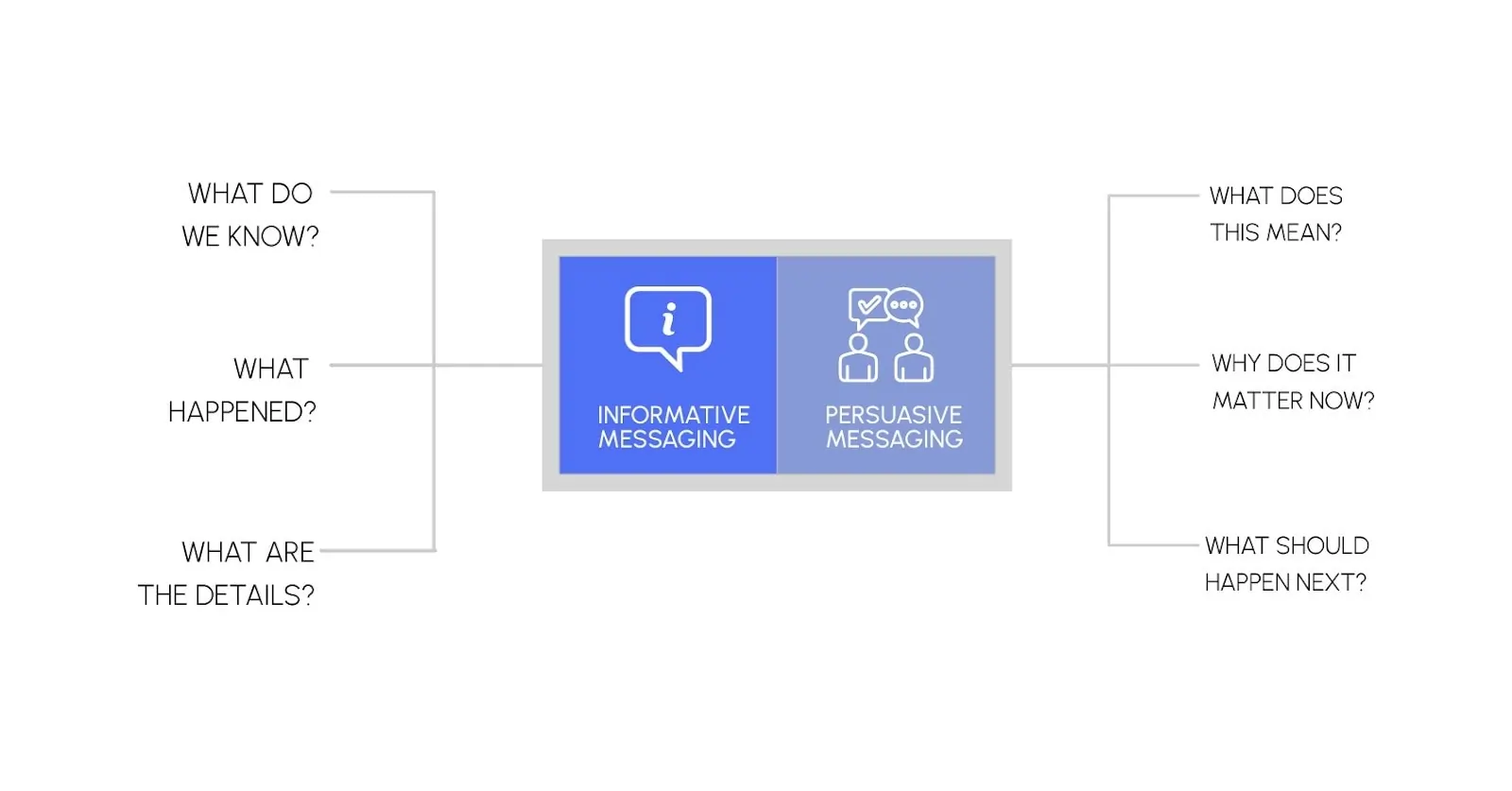
The vast majority of speeches always have an informative part. They declare the existence of something, the occurrence of something, or the possibility of something. Although this is important when disseminating knowledge, it is not important when arriving at a decision. An informative message describes facts, but does not go beyond that.
Persuasive presentations take this a step further. They also assist in the definition of meaning, relevance, and actions that are at the root of the fundamentals of presentation skills
Informative messaging answers:
- What do we know?
- What happened?
- What are the details?
Persuasive messaging answers:
- What does this mean?
- Why does it matter now?
- What should happen next?
Through the process of directly answering the questions, the persuasive communication eliminates the issues of Vagueness and speeds up the process of alignment. This is because the process of interpretation is taken out of the audience's realm, and this is why so much of the presentation on communication is about meaning and not volume.
This difference is key to understanding what makes a persuasive communication. Persuasion is not created by urgency or emotion. Persuasion is created by meaning. When meaning is understood, alignment will occur.
Patterns That Weaken Persuasive Communication
The persuasive power of communication is lessened if the message is unstructured. These patterns are proven to have less persuasive power in leadership, sales, and internal communications.
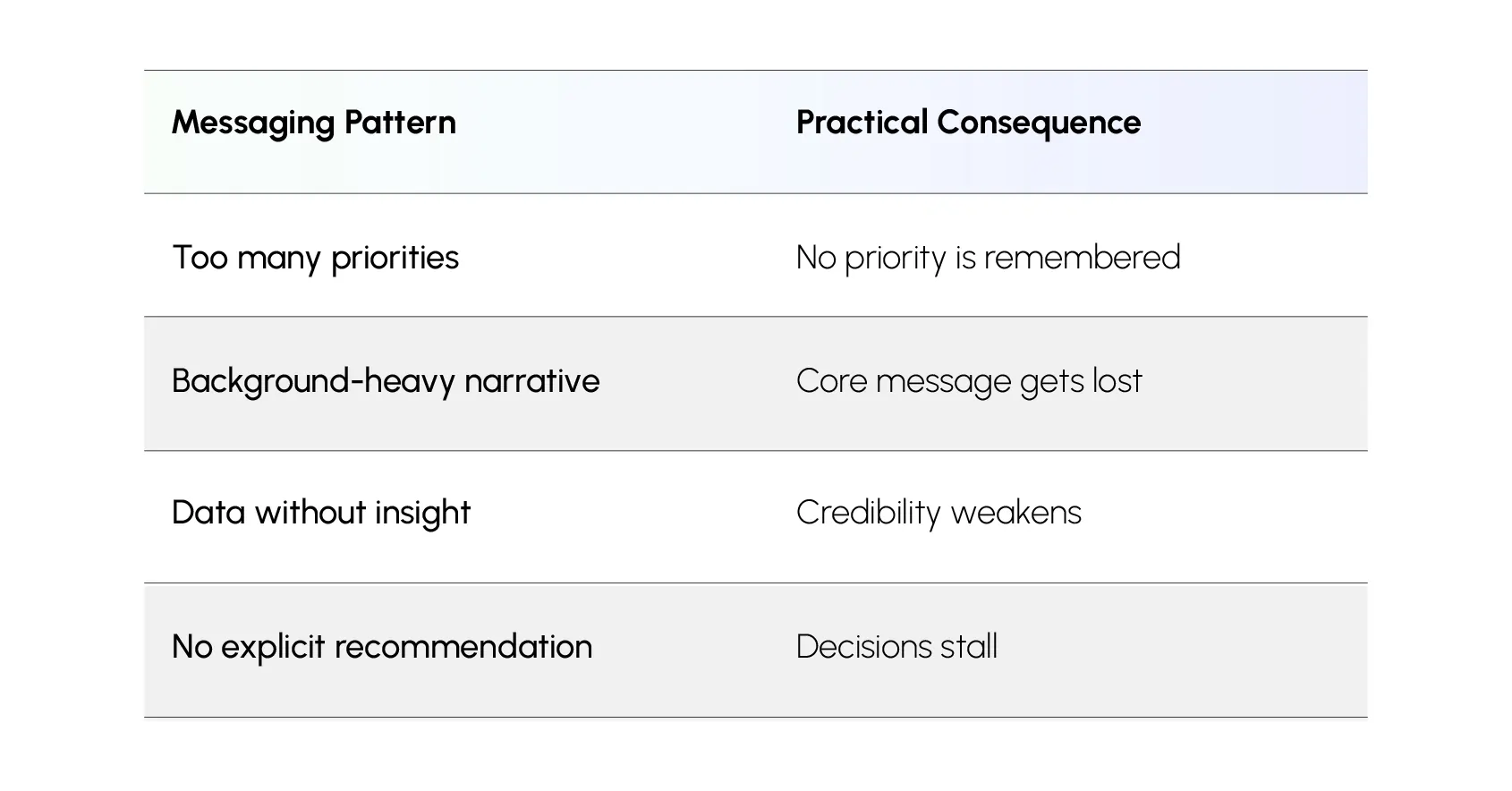
Shorter presentations with clear structure are more effective, as poor ones are typically 12 pages longer. Such patterns cause friction. They impose synthesis on the audience. This makes one feel less confident. It also slows down decision-making. Good persuasive messages do not cause such problems.
A simple rule applies: If you have to clarify your message after presenting it, then you have not been persuasive enough with your message. This is just one of the ways that structuring a message removes confusion.
A Structured Approach to Crafting Persuasive Messages
The most persuasive way of persuasion is through a systematic way of persuasion that can be replicated each time. The systematic way that will be explained below symbolically shows how a decision-maker will process information in a natural way. A message that has a systematic way of persuasion will be more easily understood and acted upon.
Anchor the Message to One Clear Takeaway
Each persuasive message must contain one takeaway that affects a decision. A takeaway is more than a summary of a message. It is a position. A position that cannot be summarized in one sentence is not a clear position yet. That message has not been developed.
Select Proof That Directly Supports the Takeaway
The art of persuasion demands specific proofs and not overall evidence. A jury would only have to be convinced of two or three well-chosen points of proof, evidence, examples, and comparisons.
Remove Content That Competes for Attention
Content competing for attention. Removing conflicting information helps increase clarity. "Interesting but unnecessary information on slides reduces persuasion by dividing your audience’s attention.
Close with Explicit Direction
Persuasive Speaking has an endpoint. Whether it is for approval, alignment, or action, the way forward is clearly the next step. This is what turns explanation into influence.
This is the kind of structure that turns explanation into influence. And most of the best tips in persuasive presentations are based on this structure.
Why Clarity Outperforms Confidence
Lack of clarity in recommendations is fragile, but lack of confidence with clarity is a rare occurrence; however, when it happens, its potency is high. Decision effectiveness studies have indicated that a lack of clarity in recommendations is one of the reasons that cause delays in senior-level decisions.
Clear messaging delivers three outcomes at once:
- It reduces uncertainty
- It signals preparedness
- It builds trust in judgment
This is why clarity is the most persuasive device that an individual has, and it is much more persuasive than tone, style, and design.
From Information to Persuasion: A Practical Illustration
Informative message
"Our product adoption slowed due to onboarding complexity, feature discoverability issues, and support response times."
Persuasive message
"To increase adoption next quarter, simplifying onboarding should be the priority, as over 65% of drop-offs occur within the first two sessions."
The persuasive version does not add more data. It adds interpretation and direction. This is persuasion through clarity, not emphasis.
Data-Backed Persuasion Builds Credibility
To influence people through persuasive communication, one needs to have those communications backed up with credible information. Based on information from Gartner, people in the position to make a decision will be influenced to make a move based on the information presented to them in terms of data that has been interpreted as opposed to data that has been quantified.
It is the strength of the data that is important, not the quantity of the data, and the strength it holds for the message. The data that has been interpreted helps to reassure the audience that the findings that have been presented are not speculative.
Persuasion Without Pressure
The Power of Persuasion The application of persuasion in a professional setting does not involve promoting one’s agenda. This activity involves promoting informed decision-making. Ethical persuasive communication begins with relevance, transparency, and intention. The audience needs to see the logic on both sides of the argument and the suggestion. This is particularly crucial in the setting of leadership and professional engagement platforms where credibility is as important as conviction.
A Practical Checklist: Is Your Message Persuasive?
Use this checklist to evaluate whether your messaging structure drives decisions:
- Can you state the primary takeaway in one clear sentence?
- Does every slide reinforce that single takeaway?
- Are all data points interpreted with clear implications?
- Is the desired action or decision explicitly stated?
- Have you removed competing priorities or non-essential details?
If any of these answers are uncertain, persuasion will be inconsistent.
What You Should Understand After This Section
The skill of writing persuasive messages is a crucial part of becoming competent in presentation because it can help to advance a conversation to a decision, move from information overload to understanding, and build confidence in communication structure to impact without using undue influence. All of these components form part of the bridge to becoming a competent presenter, which will be examined in the next chapters.
%20(1).jpg)