Connecting with Your Audience Effectively
Unleashing the Power of Visual Storytelling: Our Success Stories.

Apr 12, 2024
6 min read
%20(1).jpg)
Audience connection is not a technique applied at the end of a presentation. It is the foundation on which clarity, persuasion, and credibility are built. When audience connection is weak, presentations fail quietly. The content may be accurate, logically structured, and visually refined, yet still feel disconnected.
This disconnect is rarely caused by delivery or design. It occurs when the message has not been aligned with what the audience cares about most. In professional environments, audiences do not evaluate presentations based on effort. They evaluate them based on relevance.
Research consistently shows that presentations tailored to audience needs generate significantly higher engagement. The ability to connect with your audience determines whether attention is sustained, understanding is achieved, and decisions follow. Without this connection, even strong arguments lose momentum.
This guide explains how meaningful audience connection is established, why relevance consistently outperforms detail, and how presenters can adapt messages without weakening intent.
Why Audience Connection Determines Presentation Impact
Each audience is faced with limited time and a set of expectations. Executives, customers, and internal audiences are not waiting to hear general information. They are waiting to hear how the information affects them.
The relevance of relating to your audience is in the response to an underlying question in every room: Why does this matter to me? If that is not answered in the first few minutes, then your audience will no longer be listening.
Engaging the audience effectively is a goal-oriented act that is not an information-gathering act. The act in presenting is not driven by the things that the person presenting has to talk about but by the things that the audience has to be able to understand. The presentation that has the audience at its center creates relevance from the start.
Understanding Audience Needs Before You Present
Audience engagement starts before the delivery of the presentation. This is done through understanding audience needs. Roles, responsibilities, risk exposure, and decision-making authority determine audience needs.
Effective presenters do not assume what the audience wants to hear.
They clarify:
- What decision does the audience influence
- What constraints shape their thinking
- What level of detail supports clarity rather than confusion
This is what enables speakers to create a message that is perceived to have relevance in the moment. Otherwise, the presentation will resort to a general message, and it is left to the interpretation of the audience.
The Cost of Ignoring Audience Needs
When audience needs are not considered, several predictable problems emerge:
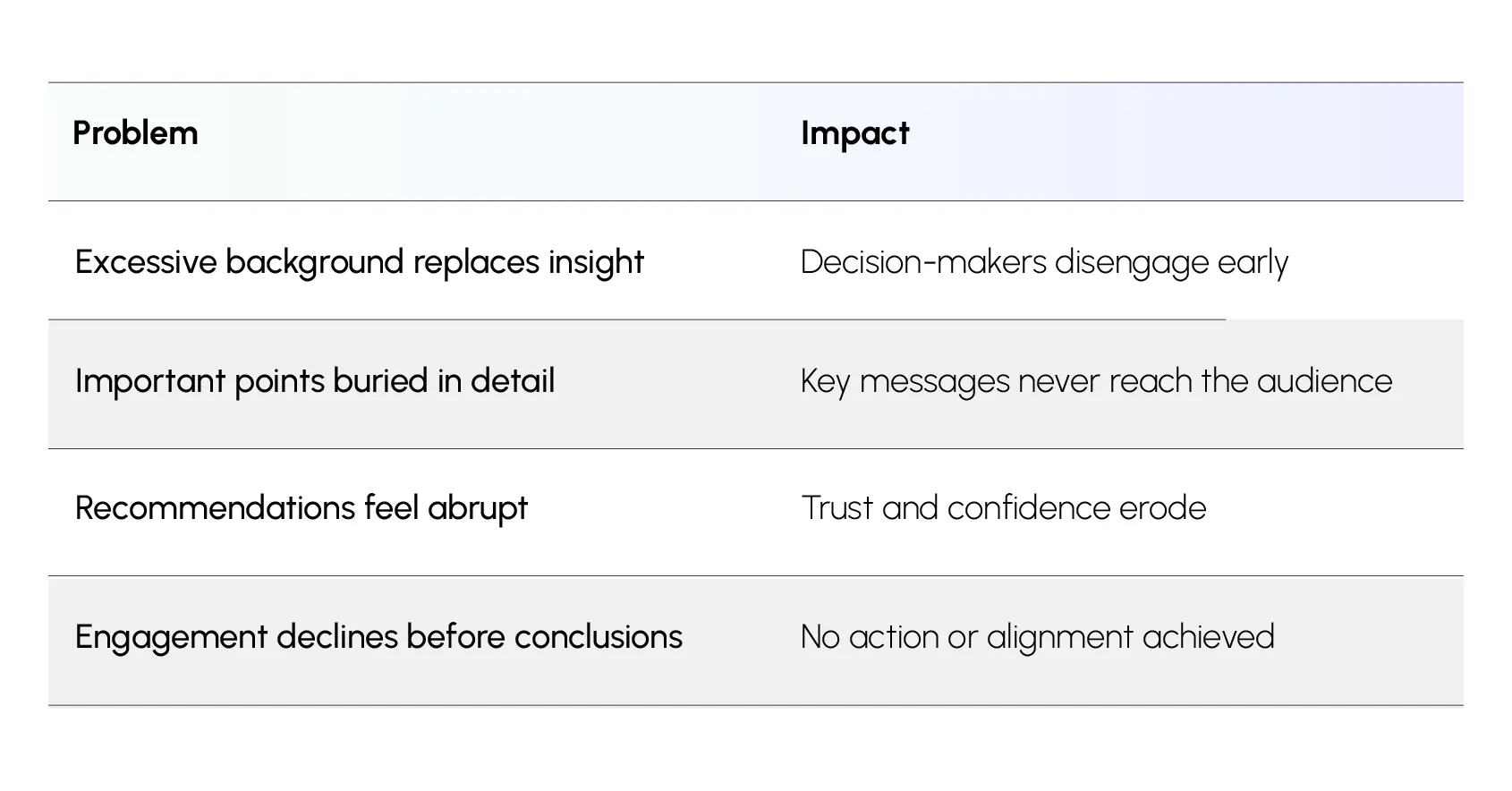
These issues are often mistaken for attention problems. In reality, they are relevant problems. Strong audience connection prevents these breakdowns by aligning message structure with audience expectations from the start.
When presentations align with real audience priorities, engagement rises instantly turning passive listeners into active stakeholders who want to move forward.
A Practical Framework for Audience Analysis
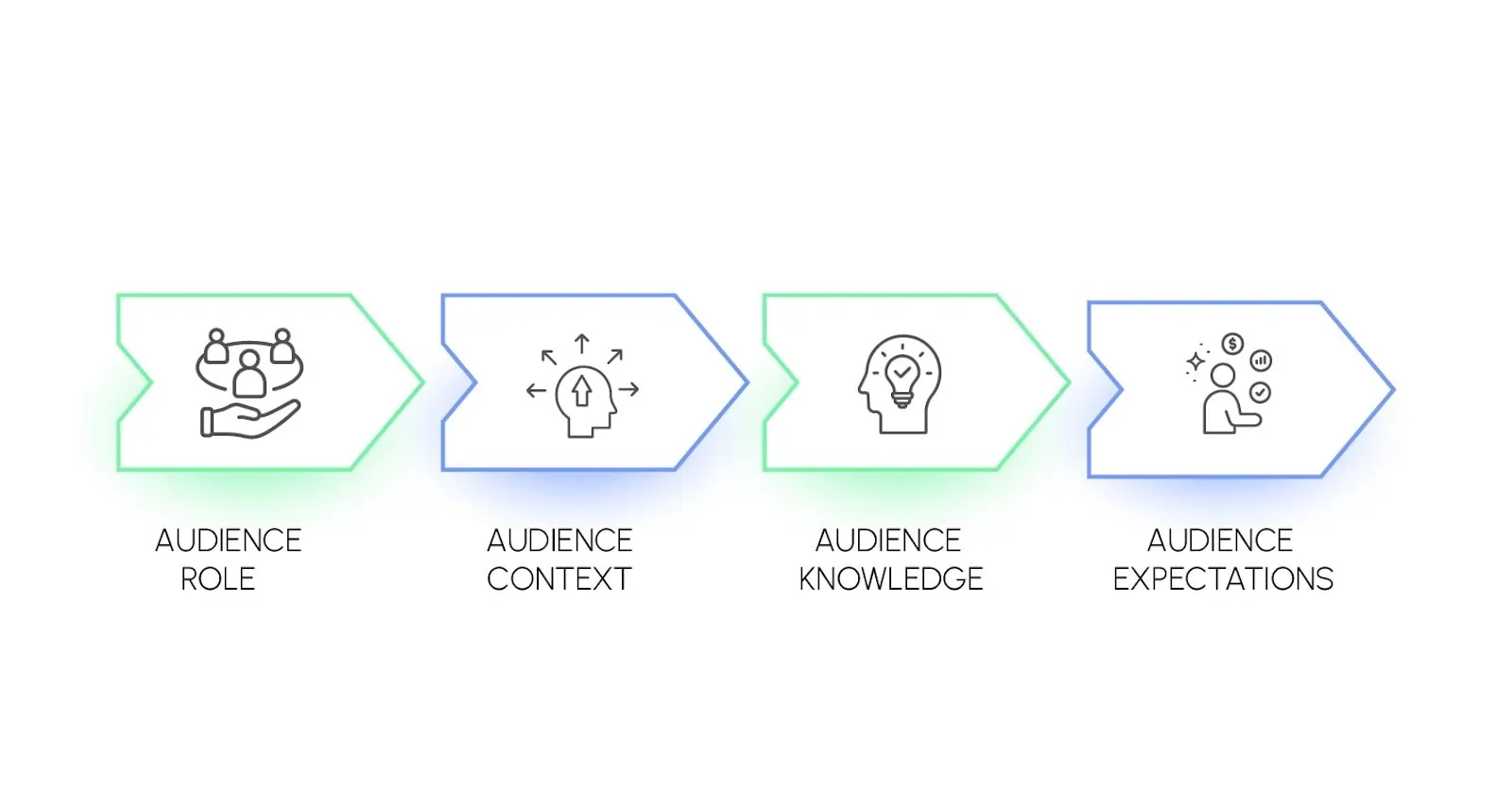
The key to effectively engaging audiences is to begin with analysis. Before making a presentation, the presenter should know who they are presenting to and for what reason this audience is before them.
Four dimensions should always be evaluated:
- Audience Role – Are they decision-makers, influencers, or implementers?
- Audience Context – What pressures or priorities shape their perspective?
- Audience Knowledge – What do they already understand, and what do they not?
- Audience Expectation – What outcome do they anticipate from this presentation?
This approach eliminates any guesswork and improves linking to audience effectiveness whether it is live, virtual, or a combination of both.
Adapting Messages Without Diluting Intent
The function of adaptation to the audience does not involve altering the message. The function of adaptation to the audience involves altering emphasis. The emphasis changes while the message remains the same.
Various audiences require relevance of differing types:
- Leadership audiences focus on implications, trade-offs, and outcomes
- Client audiences respond to value, confidence, and risk clarity
- Internal teams prioritize execution steps and operational alignment
This is because adaptation helps maintain message integrity and increases audience connection. This is because it helps speakers maintain accuracy and relevance of messages to their audience.
Why Generic Messaging Fails to Connect
The generic presentation is meant for everyone and usually resonates with nobody. Using the same presentation for different audiences may show efficiency, but it may also show a lack of thinking. The audience will be quick to sense that a message was not meant with their perspective in mind.
Indicators that a presenter may not have effective audience connections include:
- Overloaded slides trying to cover all bases
- Vague conclusions that please no one
- Mixed levels of detail are confusing everyone
- Unclear decision points are frustrating decision-makers
These patterns weaken the link to the audience because the audience has to discover the relevance on their own. An effective presentation avoids this issue because it points to the relevance immediately so that the audience can focus on the alignment and action phases.
Connecting With Your Audience in Virtual Settings
The relevance of relevance becomes even more pronounced in the case of virtual presentations. As there are no physical appearances, relevance has to reach sooner.
Strong virtual audience connection relies on:
- Crystal-clear structure from slide 1
- Short, focused sections (3-5 minutes max)
- Explicit takeaways after every major point
- Controlled pacing with built-in pauses
Virtual environments punish ambiguity more quickly than in-person settings. Clarity becomes the primary engagement tool when physical presence is absent.
Using Audience Feedback to Refine Connection
Audience engagement is enhanced by feedback. Questions, follow-ups, and points of confusion offer clues to the interpretation of the message. Good presenters are not reactive to feedback.
Over time, audience feedback reveals:
- Where relevance was immediately strong
- Where assumptions caused disconnects
- Where clarity needs reinforcement
- Which framing approaches resonate most
This feedback loop enables speakers to hone their messaging examples of connecting with the audience in several speeches.
Real-World Audience Connection Examples in Practice
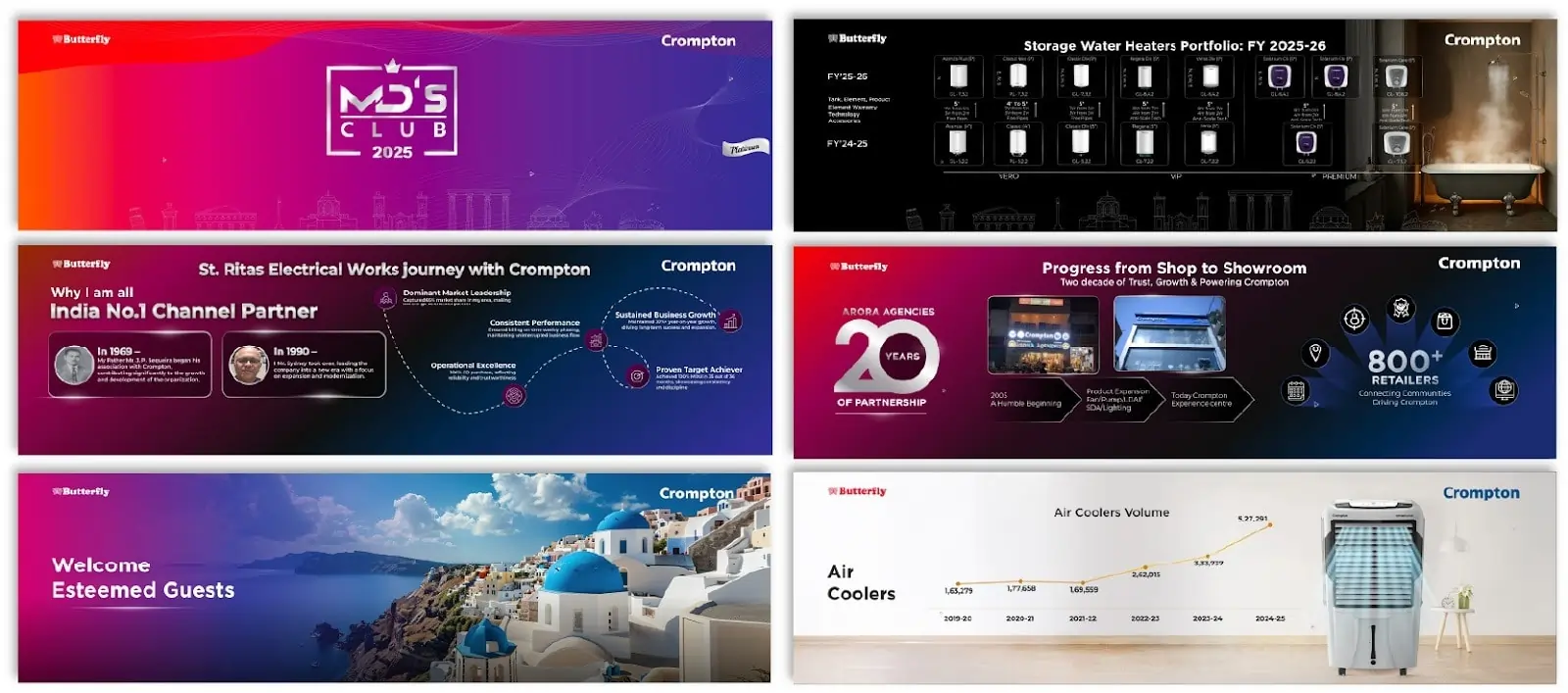
INK PPT's example of working for the Crompton MD Club 2025 shows how connecting with an audience makes a difference in audience engagement. The presentation had to target two different audiences in different ways because of their expectations and agendas.
The challenge was to tell a consistent story and address varied information demands. The executives needed strategic insights, and partners needed information on execution.
The approach involved developing audience-specific versions of the content:
- Executive decks focused on growth strategy, market positioning, and ROI implications.
- Partner decks emphasized revenue opportunities, support systems, and co-branded execution plans.
The result was sustained engagement across both groups, achieved through targeted framing rather than separate messaging. This example shows that effective audience connection comes from thoughtful adaptation, not reinvention.
Want presentations that adapt to every audience, without multiplying the work? Let’s build decks that speak differently but win together.
Audience Connection as a Persuasive Advantage
The effectiveness of persuasion increases as a result of having a strong connection with the audience. There will be less resistance to persuasion and faster learning as a result of having a connection in messages relating to priorities. Persuasion will take place in an effortless manner as there will be relevance from the start.
A strong connection with the audience means that there is no need to repeat what has already been presented. There is no need to elaborate or clarify what has already been presented. The moment relevance becomes less of an issue; everything becomes smooth-sailing. This is one of the guaranteed advantages of audience connection strategies.
A Practical Checklist: Test Your Audience Connection
Before presenting, evaluate the message using this checklist:
- Is the relevance clear within the opening 30 seconds?
- Does framing match specific audience priorities and responsibilities?
- Is the level of detail appropriate for their decision-making role?
- Is the expected decision or action explicitly stated?
- Have you removed content irrelevant to their immediate needs?
If any answer is uncertain, audience connection will weaken, and the impact will suffer.
What You Should Understand After This Section
The ability to effectively engage with the audience means that presentations can hold their attention without exaggeration, make the message more relevant and memorable, speed up alignment and decision-making, and build credibility in any context. All this supports persuasive communication and builds a basis for advanced storytelling and delivery principles.
%20(1).jpg)