Understanding the Basics of Presentation Skills
Unleashing the Power of Visual Storytelling: Our Success Stories.

Apr 12, 2024
6 min read
%20(1).jpg)
Presentation skills are often misunderstood. Many professionals assume that strong presentations are created by having a well-designed slide deck or polished skills. While slides are important, they are only a delivery medium. The real strength of a presentation lies in how clearly ideas are structured, how effectively messages are communicated, and how well the presenter aligns with the audience's expectations.
In modern workplaces, presentations influence decisions, funding approvals, leadership alignment, and client trust. Yet most professionals are never formally trained in the basics of presentation skills. They rely on templates, copied slides, or a generic ppt without understanding the fundamentals that make presentations effective. This is where structured presentation skills training becomes essential.
This guide builds the foundation. Before learning design principles or advanced delivery techniques, it is critical to understand what the real skills truly involve and why they matter.
What Presentation Skills Actually Mean Today
In professional settings, presentation skills are used in situations involving the explanation, justification, and coordination of information. This is not done during presentations alone, but during analysis, update, and decision-making sessions. Each of these processes is impacted by the effectiveness of the communication that takes place.
In terms of application, the basics for the skill of presentation revolve around discipline. This is in terms of having a specific objective, organizing information in a proper manner, and ensuring that the information that has a significant impact is emphasized.
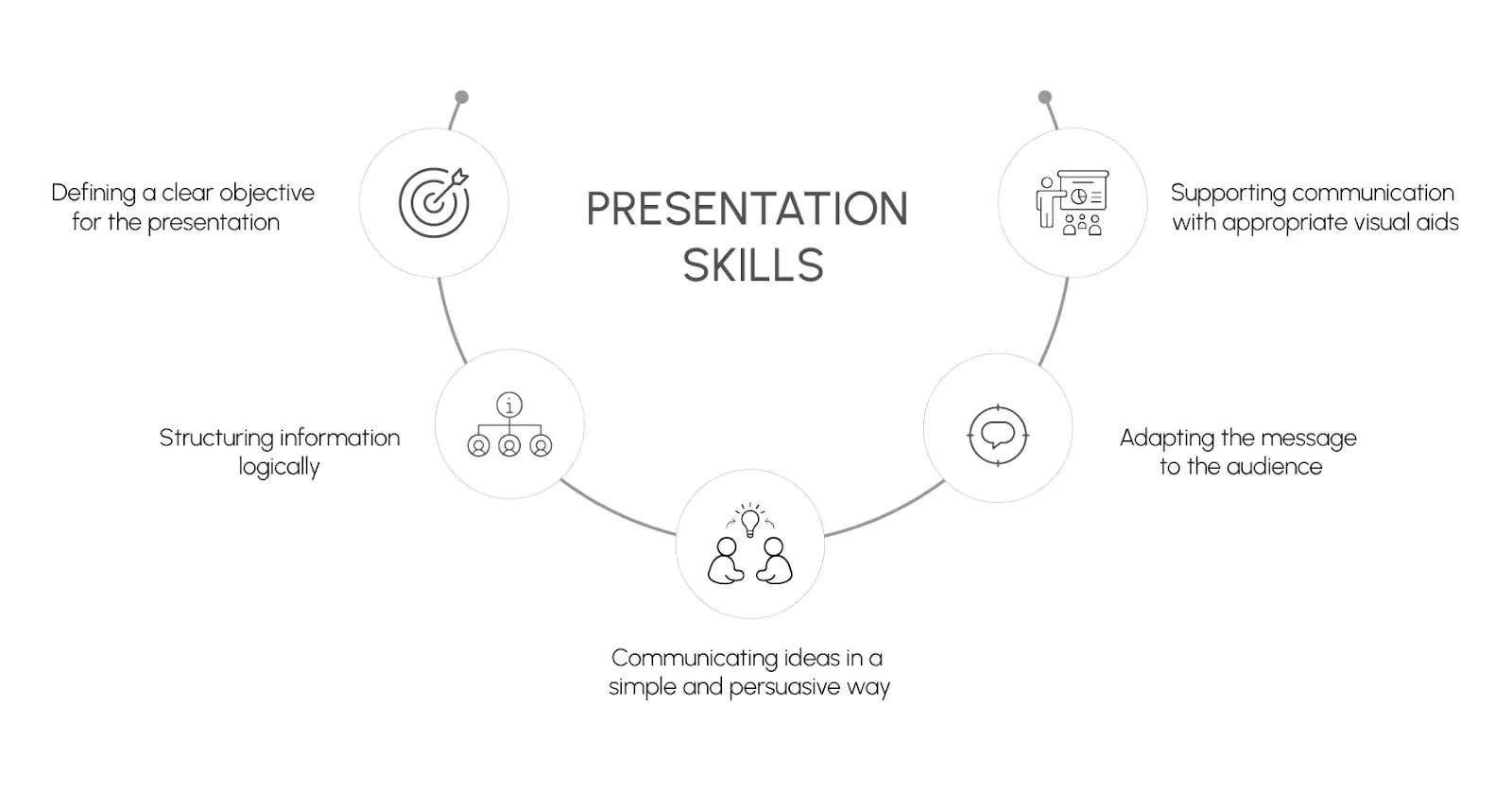
Effective presentation skills enable professionals to:
- Defining a clear objective
- Structuring information logically
- Communicating ideas in a simple and persuasive way
- Adapting the message to the audience
- Supporting communication with appropriate visual aids
Slides with visuals are 43% more likely to be retained by audiences. It is for this reason that professional training for presentations using PPTs has become less graphical and more functional. Presentation skills help one take the audience through ideas rather than bombarding them.
Why Presentation Skills Matter in Business Communication
The skill of presenting is a significant tool for conducting business communications. Every major business decision has some sort of presentation to substantiate it, whether it is a leadership update, a client meeting, or a strategic review. Presentations are a significant tool for conducting business communications.
The value of presentation skill training is evident when weighing the following possible outcomes of poor communication:
- When the message is not clear, decision-makers lose their confidence.
- Alignment becomes difficult for teams due to dispersed information.
- Opportunities are lost when value is not communicated effectively.
The skills of public speaking are often used like Band-Aids when there is no actual understanding of the subject being presented. The skills of public speaking can be used to help one present information in a way that simplifies it while focusing the audience on the end result.
One thing that has been discovered by research studies on communication in the workplace is the fact that the span of attention in a meeting is getting smaller, and the problem of information overflow is increasing. The span of attention for individuals in a presentation has reduced to an average of 10 to 15 minutes, and 52% of the individuals in a meeting lose interest after the 30-minute mark. The importance of having proper presentation fundamentals cannot be stressed enough. Good presenters are not the individuals who talk the most, but the individuals who make it easier for others to decide.
Avoid losing the audience's attention in the middle of your presentations. Develop skills to present that enable the audience to comprehend, retain, and decide.
What Breaks When Presentation Basics Are Weak
When presentation fundamentals are missing, problems appear long before delivery. These issues are often mistaken for design flaws, but they are rooted in weak basics.
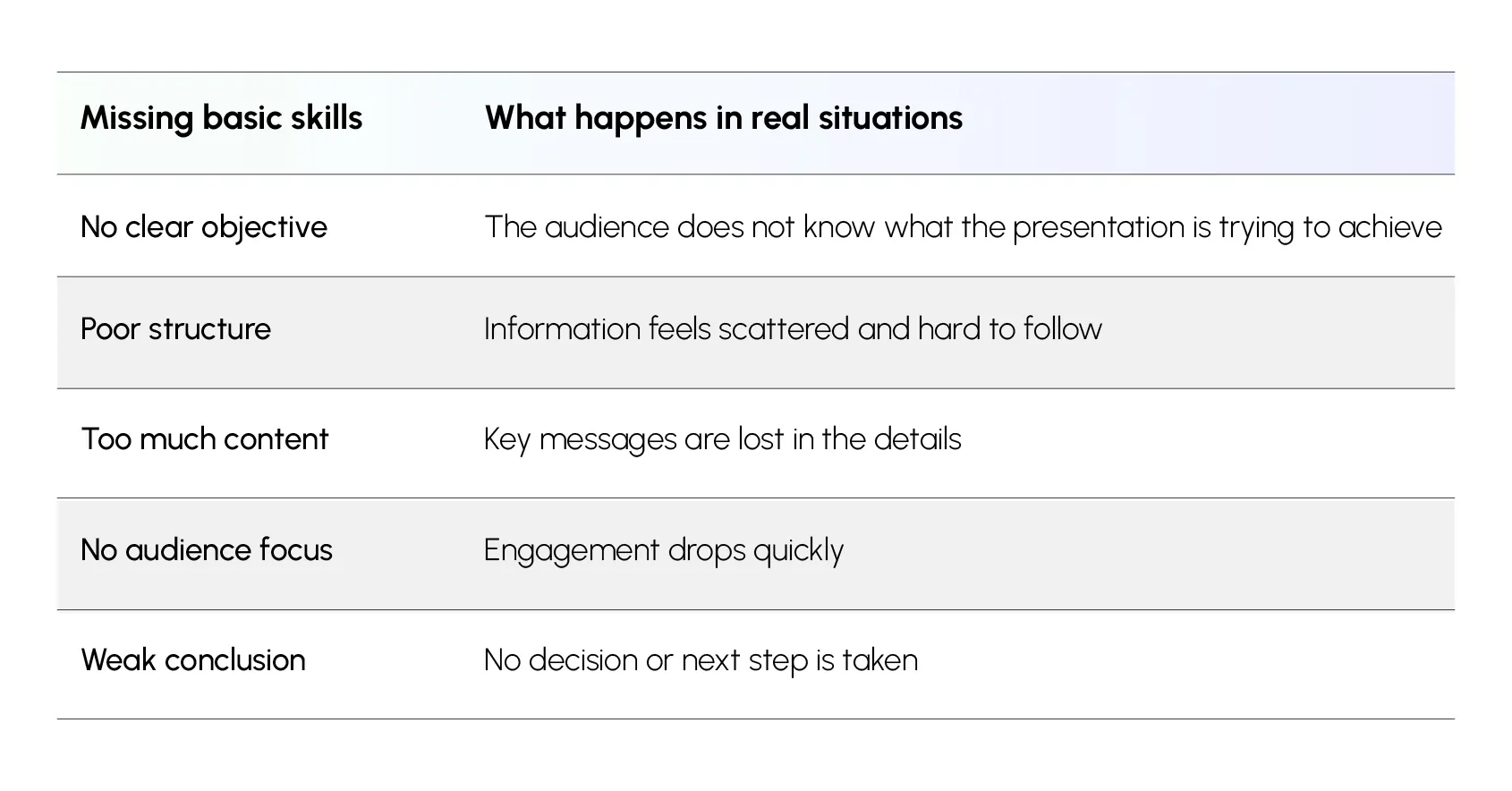
In most cases, teams have attempted to address the challenges by creating the design for the slides or through the introduction to the skill for the PowerPoint presentation. Even in this case, the design could assist in ensuring uniformity, but it is not an effective way to address the problem.
To increase the effectiveness of the communication process, it is important to identify where the problem of poor communication occurs and why this issue happens. In order to establish a solid structure, it is essential to address the foundation rather than adding layers to it if the foundation is not solid.
Ready to turn knowledge into confident, effective presentations? Develop presentation skills that drive clarity, engagement, and decisions.
Essential Skills That Form a Strong Foundation
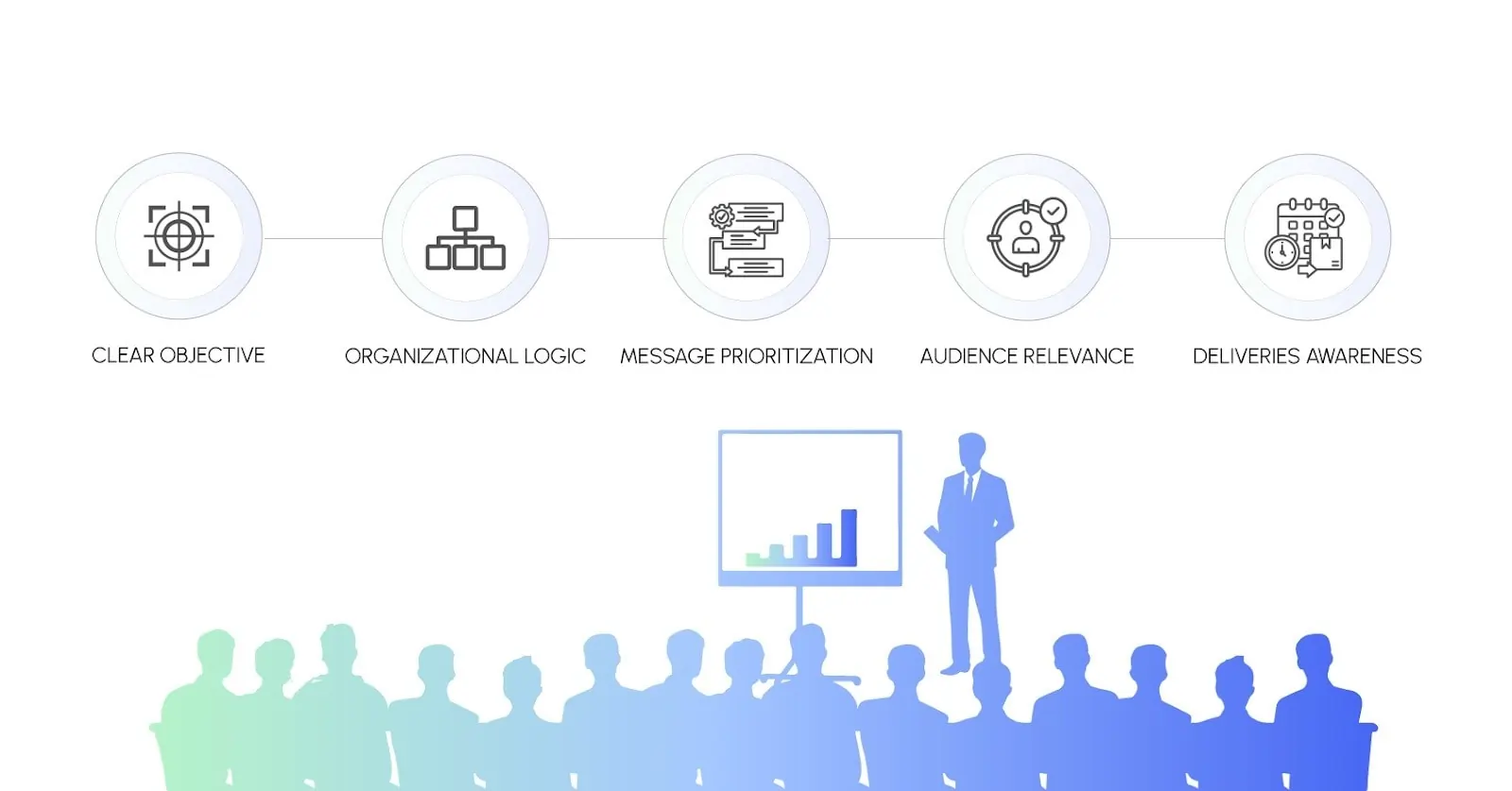
Communication does not depend on style, personality, or type of presentation. In all fields and in all capacities, it relies on the same basic set of presentation skills that are applied universally. Such skills result in simplicity, reduced cognitive overhead, and scalability of the message.
Purpose Definition
Idea structuring must be intuitive to the audience. A smooth flow from context to insight to conclusion is helpful in information processing with ease. A disorganized structuring of ideas may sometimes increase cognitive load despite the effectiveness of the ideas.
Organizational Reasoning
Ideas need to be organized in a manner that will resonate with the audience. A logical flow from context to insight to conclusion is a great benefit to the audience in terms of the information. Poor organization will increase the cognitive load and decrease retention, even for excellent information.
Information Prioritization
All information is not of equal importance. A skilled communicator identifies the information that is of prime importance and the information that is supplementary in nature. A skilled communicator removes unnecessary information to focus on areas that affect the understanding.
Audience Awareness
Good presenters will change the frame, level of detail, and emphasis according to the role, expectations, and familiarity of the audience. This is because what will work for one group of people will not work for another group of people if the context of the message for the audience is not considered.
Delivery Awareness
Basic delivery elements, such as pacing, tone, and clarity of speech, affect how messages are perceived. While advanced techniques can enhance impact, these fundamentals establish credibility and confidence from the outset.
Each of these skills for effective presentation skills training is essential and together comprise the foundation of all effective presentation skills training PPTs. These skills help professionals communicate effectively and achieve their goals.
From Slides to Skills: Why Training Matters
The most common attempts that have been made in order to improve the design of the presentation have been at the slide level. Resources have been spent on designing templates that are standardized in Microsoft PowerPoint. Although this improves the superficial consistency, there is nothing that can be done to improve the structure of information or message design.
The problem with a slide-first approach, though, is quite straightforward. Templates provide a solution to a problem of appearance, not a problem of clarity. They do not provide any value to presenters in understanding their message intention or what information needs to be communicated in a message, or understanding a message to an audience.
Presentation skills training fills that gap. The training changes the emphasis from creating slide shows to cultivating judgment. Skilled presenters don’t start with selecting designs. They first respond to basic questions:
- What decision or understanding is this presentation meant to enable?
- What does the audience already know, and what do they need from this discussion?
- Which information materially supports the message, and which does not?
- How should attention be sequenced to support comprehension and decision-making?
The use of presentation skills training PPTs will only make sense if they are used as learning tools and not as reference presentations. The best use of presentation skills training is in situations such as those mentioned below. Presentation skills training can be used to offer frameworks, comparisons in terms of examples, and disciplined thinking in terms of practice.
See Presentation Transformation in Action
Before delving into more advanced structure and narrative, here is an actual example of how common presentations can be leveraged into effective communication tools when revized in a strategic way. The following is a video presented by INK PPT that illustrates how design, clarity, and narrative can come together to achieve greater levels of audience engagement and retention.
It showcases how revisualization helps turn scattered slides with text into visual stories that clarify complex information. With a clear message communicated through meaningful design rather than mere decoration, your audience will connect with you faster, and progress will be made with confidence with each presentation.
What You Should Understand After This Section
By being conscious of the basic principles of the art of presenting, professionals can have a clear understanding of the success or failure of the presentation. The secret to successful presentations is not in memorized lines or in the secret PowerPoint on the topic of “presentations.”
One has to master the fundamentals before moving on to the topics of storytelling, designing, and presenting techniques. The training program for developing presentation skills sets up this foundation so that each slide, message, and presentation results in a major objective.
%20(1).jpg)