Defining the Objective of a Presentation
Unleashing the Power of Visual Storytelling: Our Success Stories.

May 2, 2024
6 min read
%20(1).jpg)
Work fails long before the first slide appears on screen. It fails the moment a presenter enters a discussion without a clearly defined presentation objective. In most organizations, communication is created reactively. A deck is requested, a meeting requires content, or a leader asks for an update. Material is assembled, information is gathered, and visuals are refined. Yet one critical question is rarely addressed with precision: What is the purpose of a presentation?
This omission is not incidental. It is the most common reason business discussions feel prolonged, unfocused, or inconclusive. Without a clearly defined objective, even well-designed material lacks impact. Communication that attempts to inform, persuade, align, and drive decisions simultaneously often fails at all four. This topic exists to correct that pattern by shifting attention from slide production to strategic intent through defining presentation goals.
Why This Topic Exists
Work happens before the first slide is even put on the screen. It happens when a presenter walks into a meeting without having a specific presentation goal. In most companies, communication is made on an ad-hoc basis. There is a request for a presentation, there is a need for information at a meeting, or an update is required by a leader. Information is compiled, and slides are perfected.
One question, however, is not typically answered with any degree of accuracy: What is the purpose of a presentation?
This is not just an oversight. It’s the single most common reason why business conversations seem drawn out, meandering, or unproductive. Without a specific objective in mind, even highly effective content will not have any effect. Communication that informs, persuades, aligns, and influences decision-making simultaneously will fail at every level. This issue exists in order to break that cycle by moving the focus from designing slides to designing goals for presentation.
Communication without an identified purpose will:
- Lacks direction, when the flow of content is chronological as opposed to logical
- It conveys information rather than meaning, and the result is a lot of data in a discussion without any depth
- The background information overloads, hiding the key message.
- Leaves audiences uncertain about what decision, action, or alignment is expected
Engagement levels drop quickly if the audience can’t pick out the aim early. Decision-based presentations help eliminate this by conveying the aim early and focusing the audience’s attention on a specific decision.
This topic begins to ground the reader in the field that enables effective business communication: the field of purpose clarity. Before structure, before story, before visuals, the definition of purpose serves as the foundation that enables one to build upon and thus increase engagement of the presentation.
If it seems difficult to come up with a clear definition of your objective, or if you’re not sure how to begin, our team can assist in helping you gain clarity of purpose before design. A good presentation must begin with the proper foundation.
Understanding the Four Core Types of Presentation Objectives
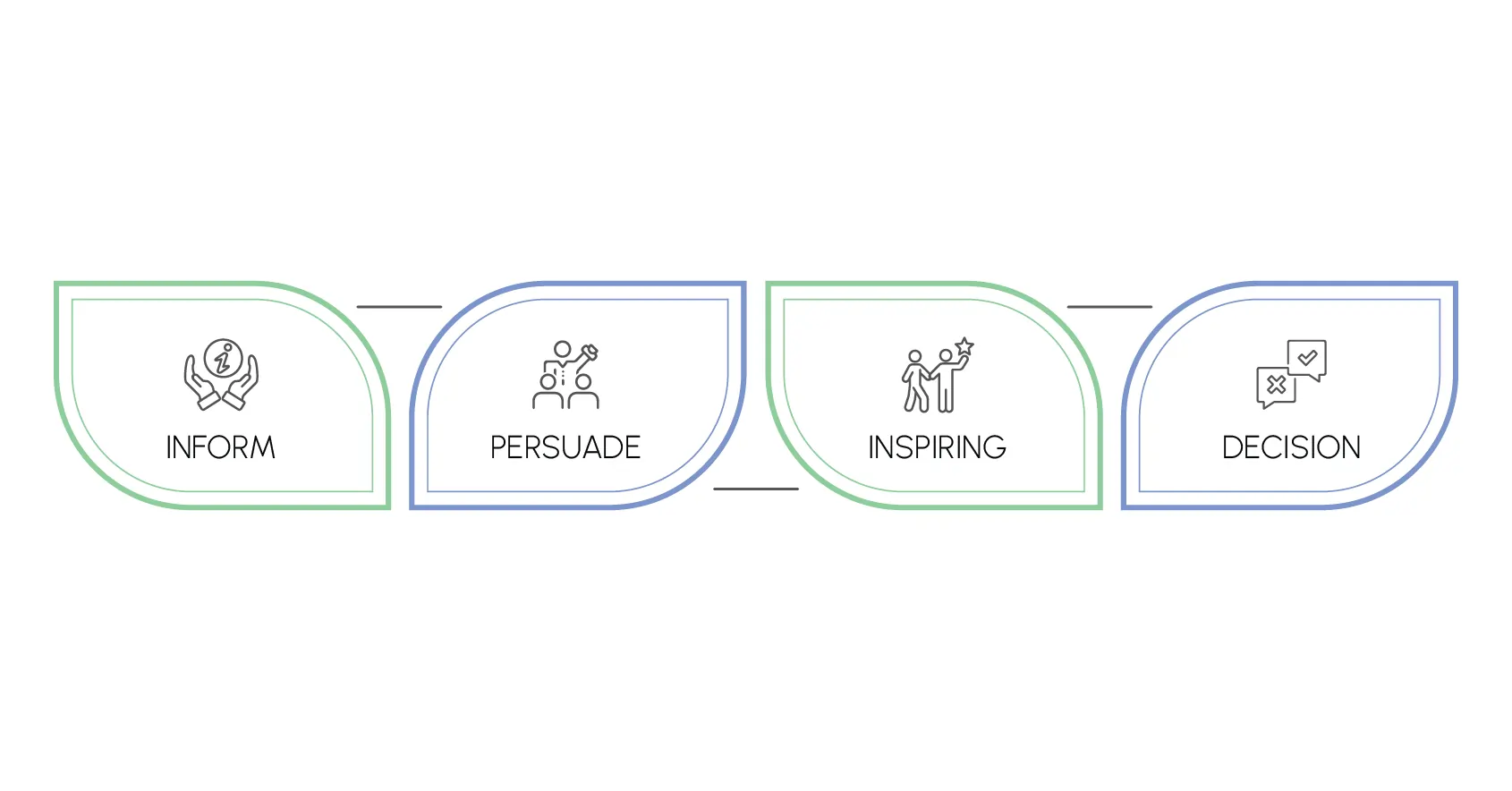
Though communication may be varied according to different industries and audiences and through different media, all business communication has one of four different types of presentation objectives. It helps to focus and avoid dilution if the right objective for communication is identified at the beginning.
So these are four objectives that provide the basic structure of any business presentation. Once the goal is established, the remaining aspects of the presentation will fall into place.
Presentations that Inform
Informative objectives emphasize understanding and clarity. Their purpose is to share information in a way that can be easily digested by the audience. Slides designed for informative goals emphasize organization and readability rather than aesthetics. Typography, placement, and contrast play critical roles in guiding the audience’s attention to important pieces of information.
Presentations That Persuade
The persuasive objectives of this presentation are to encourage decision-making or to influence thoughts. The presentation should focus on key insights, comparisons, and proof in such a way that enhances persuasion. The use of images is designed to focus on important points, while the storytelling technique is carefully planned to promote momentum and persuasion by emphasizing credibility.
Presentations That Inspiring
Inspiring objectives seek to capture attention and engage emotionally. Slides must create rhythm and impact, balancing visuals, movement, and concise messaging. Design choices amplify the narrative and maintain focus, while typography and color create energy and clarity. Here, consistency and intentionality prevent visual distractions from diluting the emotional impact.
Presentations That Drive Decisions
Presentations that influence the process of making decisions are a combination of clarity, persuasive power, and helpful information. These presentations are designed in such a way that they not only analyze information but also point towards recommendations after analysis. The purpose of these presentations is to make decisions efficiently.
85% of audiences remember visual content 3 hours later vs 70% for verbal. The beginning of an efficient communication strategy involves recognizing which type of objective is to be used. Without recognizing the type of objective, the content will result in a mixture of information, persuasion, alignment, and decision-making.
How to Define Your Presentation Objective
Defining presentation goals is not a theoretical exercise. It is a practical decision-making process. A strong presentation objective answers three essential questions:
What should the audience understand, believe, or be prepared to decide?
Your objective should center on audience impact, not presenter activity. Instead of “Walk through the project update,” aim for “Align stakeholders on the priority risks and the decision needed to keep the launch on track.”
Why does this matter now?
An effective objective creates urgency by connecting timing to consequence. Compare “Here’s the current status” with “If these risks aren’t addressed this month, the launch timeline will slip.”
How will I know the presentation succeeded?
This ensures your single objective presentation is not vague but measurable. Success = "Leadership schedules follow-up to finalize territory realignment by Friday."
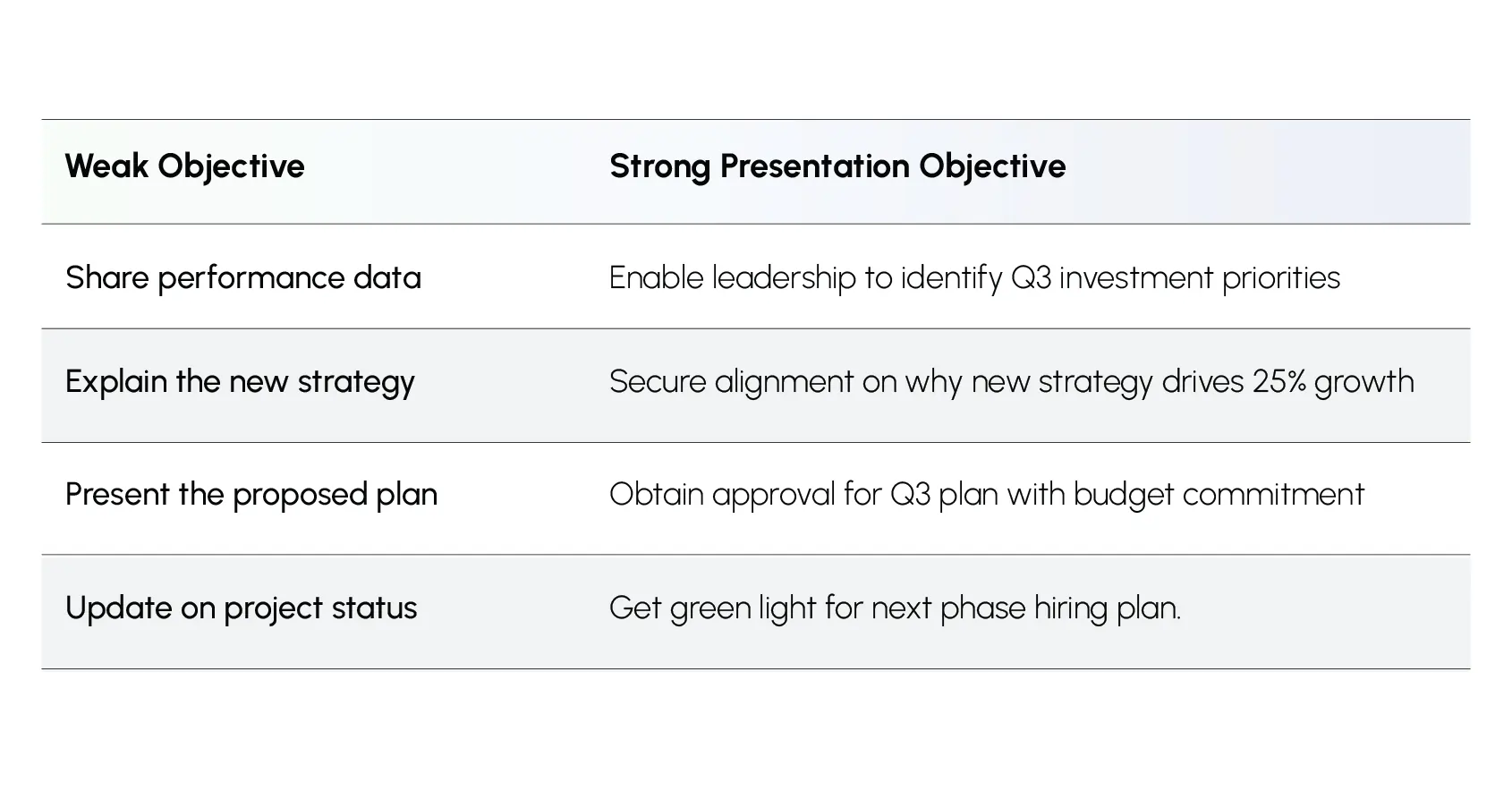
Weak Objectives vs Strong Presentation Objectives
This table shows how reframing objectives from activities to outcomes creates more focused, decision-driven presentations.
Now we are showing an example of our work - “Deloitte for SAPM 2025”.
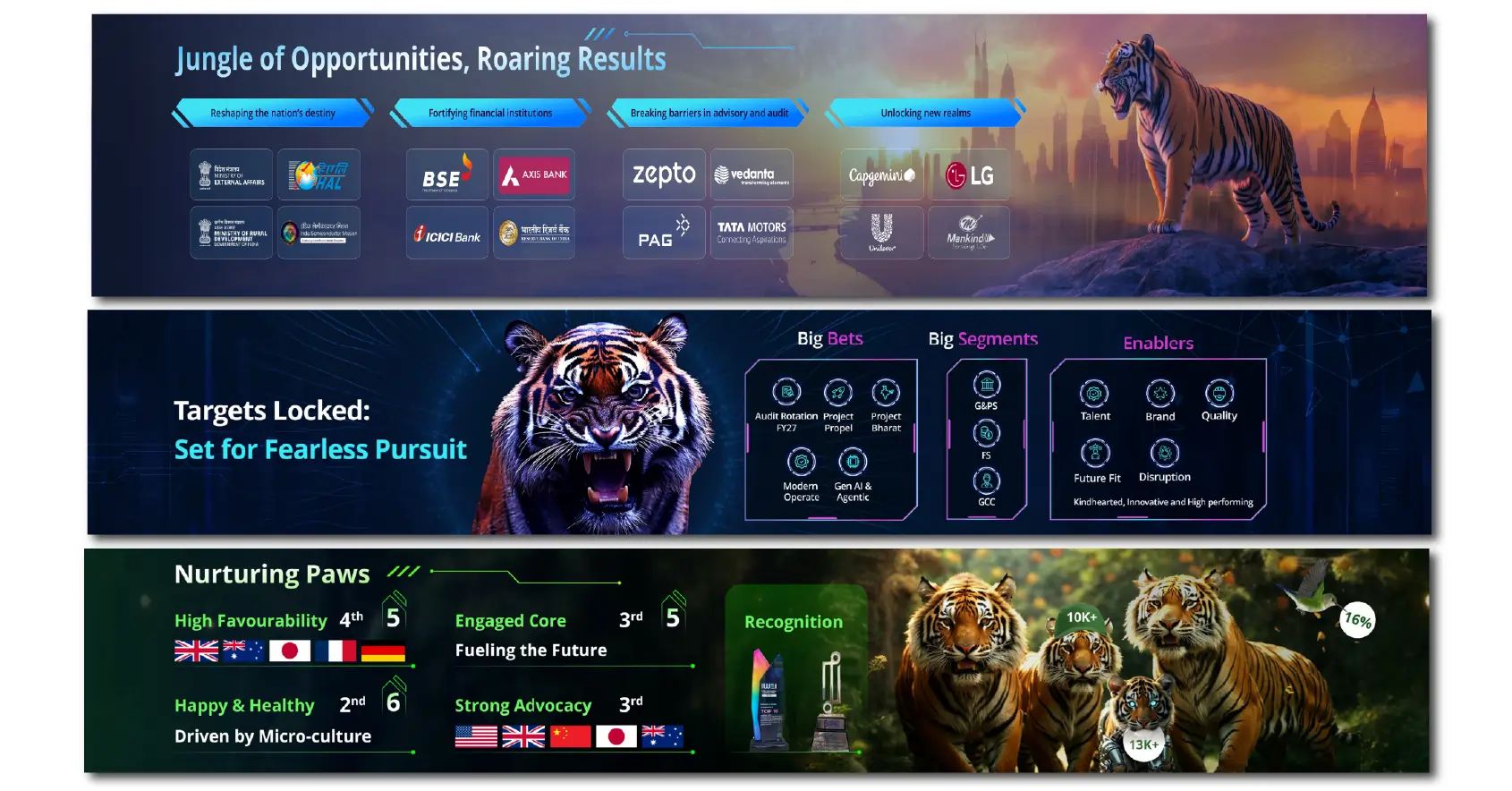
Every example illustrates how setting goals for a presentation affects the logic of a presentation. This helps to create a flow and a conclusion to a presentation to improve its engagement.
This approach, based on objectives, was adopted during the CEO keynote at Deloitte for SAPM 2025. Through the establishment of proper objectives on alignment and decision-making, the session went beyond mere sharing of information.
In this manner, the presentation was able to anchor the deck in objectives such as the promotion of mutual understanding of risk, identification of where the next action was required, and alignment of key priorities in order to achieve effective discussion as opposed to mere viewing. This was achieved in an objective-centered manner where all aspects of the presentation aligned in order to direct the thinking of the audience.
How Presentation Objectives Improve Delivery Skills
A clear objective does more than shape content. It fundamentally strengthens presentation delivery skills. When intent is precise, delivery becomes confident and controlled.
Presenters with a defined objective:
- Speak with conviction because the core message is unambiguous
- Keep explanations focused, as every response ties back to the objective
- Avoid unnecessary digressions without force or defensiveness
- Place emphasis where it matters most
- Handle Q&A strategically by reinforcing the purpose of the presentation
Consider a budget approval discussion. Without an objective, the speaker would go through the revenue, expense, and market analysis. However, with an objective like “Secure approval for a $250K Q3 reallocation,” all answers build on return on investment, risk, and readiness. Here, the speaker is not merely conveying information.
In this scenario, the presenter is no longer narrating information. They are guiding the audience toward a decision. Tough questions become opportunities to reinforce intent. For example, “Why not wait until next quarter?” can be answered by linking the delay to a quantifiable impact. Delivery improves because purpose provides the anchor.
The Lasting Impact of Purpose-Driven Presentations
Having presentation objectives redefines communication. An objective presentation will always be more effective than a general presentation.
- Eliminate 70-80% of potential content (Only what serves the goal survives)
- Create intuitive slide sequences (Logical flow emerges automatically)
- Build audience anticipation (They know where you're headed)
- Produce measurable outcomes (Success criteria are predefined)
This is noticed by teams. Leaders value clarity. Colleagues emulate your approach. The improvement in the engagement of presentations follows naturally from the disciplined goals of presentations.
A Practical Checklist for Defining Your Presentation Objective
Before creating your first slide, test your presentation objective:
- Can you state it in one clear sentence?
- Does it focus on audience action, not your activity?
- Does it address their specific priorities and concerns?
- Does it naturally filter out 80% of potential content?
- Does it create an obvious 3-part structure (problem, proof, purpose)?
Any "No" answers require immediate refinement.
What You Should Understand After This Section
Understanding the skill of setting presentation goals will empower you to easily pick the appropriate goal for a given situation and eliminate fuzzy activity communication in favor of goal-oriented communication. This will create single-objective conversations with a smooth flow, which will optimize presentation interaction.
Most importantly, this clarity builds more effective presentation skills. With success clearly understood, confidence is based on certainty, not performance. Every discussion transitions from sharing information to communicating for measurable success.
%20(1).jpg)