

Contact Us
Let’s Partner for Your Next Big Presentation
Consult with our Business Advisor
.webp)


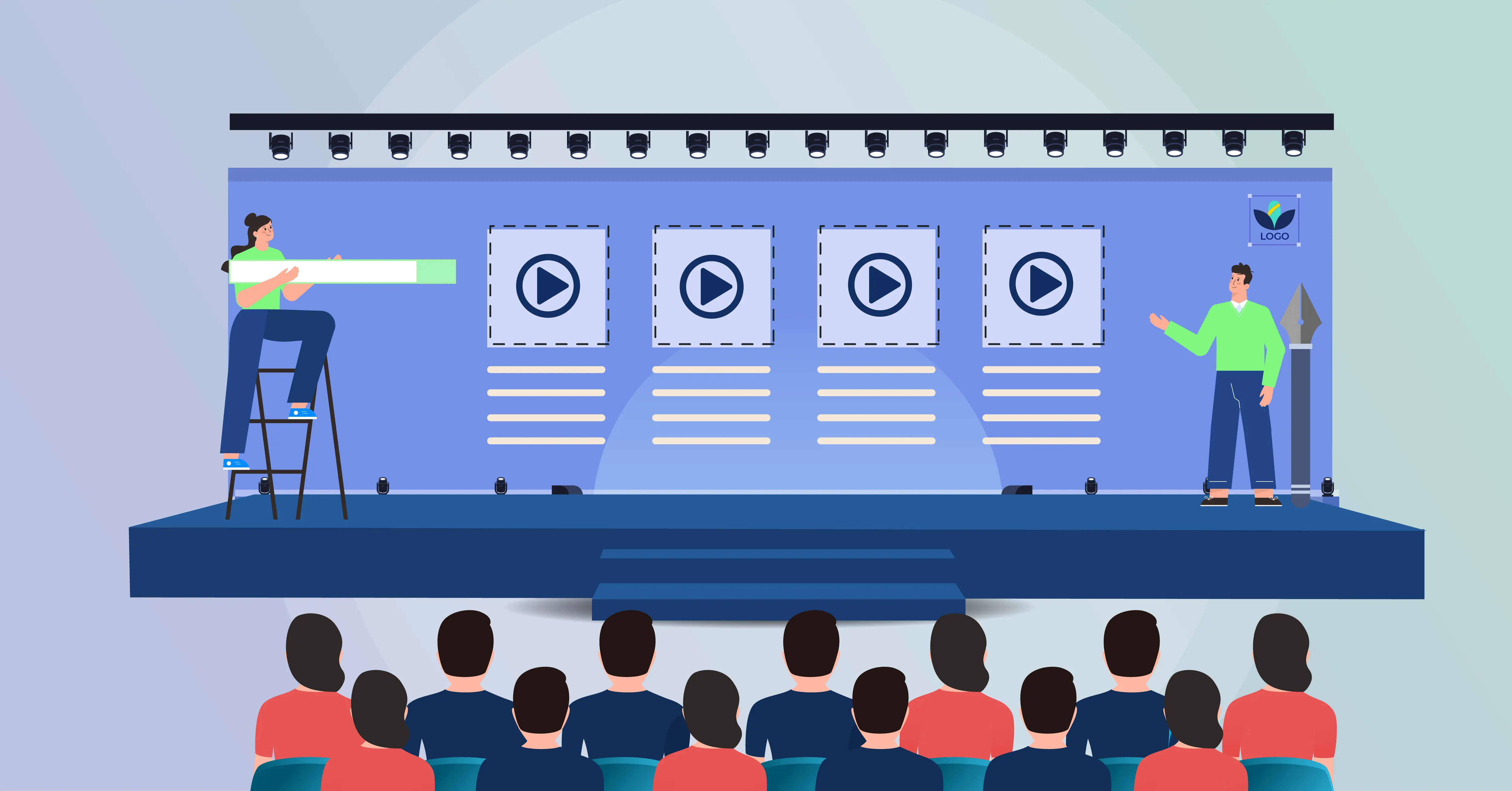
What makes event slides different from any other presentation? Event presentations do not sit quietly on a laptop. They perform live under lights, sound, and the constant movement of the audience. Event Presentation Slides have only seconds to capture attention, convey ideas, and reinforce the speaker’s message before the moment passes. Every element on the screen competes with the stage, energy, and audience focus.
High-profile events in 2026 like product launches, conferences, town halls, and leadership summits, have evolved into full-scale brand performances. Slides are no longer passive support. They shape perception, signal authority, and drive audience engagement.
Event Slide Design requires its own approach. Audiences view slides from varying distances. Screens can be massive or custom-shaped. Visuals are fleeting, disappearing almost as soon as they appear. Treating slides like documents produces decks that fail on stage. This guide explores how to craft Event PPT Slides that communicate, captivate, and leave a lasting impression in live settings.
Yet despite the advancements in technology and presentation software, many speakers continue to rely on outdated event PPT slides. Let’s look at the reasons why these approaches are not working with the modern audience:
It’s only when you are aware of the pitfalls that you can move forward to make the right changes to your slides to make them work for you as an effective tool for engagement and persuasion.
These principles focus on how Event Presentation Slides perform on stage—under lights, distance, under timing pressure, and real audience attention.
Event Presentation Slides are not viewed from arm’s length, as they are viewed from across halls, and auditoriums are often dimly lit, with visual distractions all around. This is one factor that fundamentally alters how Event Slide Design must be done.
In live events, legibility is not an exercise in beauty, as it is in digital design, where it is an exercise in instant comprehension. If the text on the slide is not understandable in the first few seconds, it is as if it is not understandable at all. Fonts may look great on a computer screen but may not look great on an enormous screen in an auditorium. Long sentences may look terrible when they are split apart on the screen, and thin text weights may disappear in the lighting of an auditorium.
This is often the first gap that is noticed when reviewing Event Presentation Slides in the real world. At INK PPT, it is often noticed that Event Presentation Slides, which were approved internally, fail when they are projected on an enormous LED screen.
In 2026, when LED walls are ubiquitous, Event Visual Slides must be designed with legibility, not convenience, in mind, as it is an exercise in instant comprehension, where the message must be conveyed without effort, friction, or distraction.
At events, it's the stage that's the main focus, not the slides. The speakers, lighting, and other audio and movement cues are already vying for the audience's attention. If the Event Presentation Slides are designed badly, they either dominate the presenter or are ignored as being irrelevant.
The most effective Event Slide Design uses slides as enhancers, not presenters of information. They're meant to augment the moment, add emphasis, and enhance the emotional impact of the presentation, rather than simply presenting information being verbally presented. When they're used to simply present information being verbally presented, one of those two mediums becomes subconsciously ignored.
This creates a rhythm of speech and visuals. For large events, where audience attention can be tenuous, slides that vie for dominance can detract from immersion. When they're designed to enhance the stage, they improve presence, clarity, and audience engagement, which are all qualities that modern audiences at events expect.
Events are emotional experiences long before they are informational ones. Audiences may forget the exact wording of a slide, but they remember how a moment made them feel. This is why the most effective Event Presentation Slides are designed around emotional beats, not content density.
Each slide should communicate one clear idea and one emotional cue. Whether that cue is anticipation, urgency, confidence, or clarity, it must be unmistakable. When multiple ideas are forced onto a single slide, emotional impact disappears.
In live settings, audiences do not “read” slides the way they do documents. They absorb impressions. This makes restraint a core principle of Event Slide Design.
This approach is especially critical in keynotes, leadership addresses, and launch events, where momentum matters. One message per slide keeps the audience aligned with the speaker and allows the story to unfold with intention and impact.
Event slides are not fixed in a controlled environment; they are projected, stretched, and even partially obstructed. Designing the Event Presentation Slides without taking these issues into consideration is one of the most common reasons why an event fails.
Professional Event Slide Design assumes variability:
This is why successful slides are designed to follow the safe zones. Important content is not placed near the edges. Visual balance is achieved by keeping the content centrally placed. Layouts are designed to be successful even when the slides are not perfectly projected without compromising the Event Presentation Format.
Customized stage configurations and non-standard screens are becoming the norm in 2026. Slides must be designed to function well across large screens without compromising the content or making it look messy. Designing for large screens is not about making it look good; it’s about making it function well.
Audience engagement at events is closely related to the subject of pacing. Slides changing too fast can be overwhelming. Slides changing too slowly can be draining. Event Slide Design is all about thinking of the slides as a storyboard, not a document.
In live events, pacing is felt more than consciously noticed. When slides change at the wrong moments, attention breaks even if the message itself is strong. This is something that often surfaces during rehearsals.
For INK PPT’s events work, the subject of pacing is not solved by adding more slides. It is solved by thinking through how long a visual moment should be given to hold the audience’s attention. Visual rhythm is no longer a nice-to-have but a necessity in the year 2026, where attention spans are short and expectations are high.
Slides not fitting the rhythm of the event can cause instant loss of audience engagement. Optimizing visual rhythm and structure can greatly improve how your event presentation does on stage.
Motion is a growing trend in Event presentations, but just as motion is a growing trend, that does not necessarily mean that motion in Event presentations is effective. Too much motion in an Event presentation can be distracting, confusing, and even uncomfortable on a big screen.
Effective Event Visual Slides use motion sparingly and correctly. Motion in an Event presentation is used for the timing, not just to show off the capabilities of the presentation software.
Audiences in an audience immediately recognize gimmicks and motion used just for the visual effects, and this kind of motion can be very distracting in an Event presentation. Conversely, motion used correctly is completely invisible, and that is exactly where motion in an Event presentation should be.
Events are brand-defining moments. Yet, having a great brand doesn’t mean you have to have your logo on every single slide. In fact, the most advanced Event Slide Design is achieved through consistency, not repetition.
Brand presence in Event Presentation Slides is established through:
This is how you build recognition, not fatigue. Your audience is consuming your brand on an unconscious level, not consciously because of branding.
Well-constructed Event Slide Templates are an important contributor to this end. They provide consistency in large presentations and multi-event schedules, yet they do so in a way that doesn’t feel rigid or repetitive. In 2026, subtlety is a sign of confidence, and confidence is what gets brands remembered.
The final and most overlooked principle of effective Event Presentation Slides is synchronisation. Slides should never race ahead of the speaker or lag behind their message.
Strong Event Slide Design anticipates moments:
The slides are used as a punctuation device, which helps to further enhance what is happening on stage. The question of whether the slides are leading the speaker or if the slides are arriving too late is important. The synchronisation of the slides is seen as a design issue rather than a rehearsal issue. The synchronisation of the experience is what helps to keep the experience cohesive, and this is what helps to take the experience from average to interesting.
Event slides should perform at scale, not just exist as files in a folder. At INK PPT, every Event Slide Design project begins with a deep understanding of audience expectations, venue conditions, and strategic objectives. We do not treat slides as documents; we treat them as visual instruments engineered to elevate communication and reinforce messaging throughout an event.
Our process centers on stage‑first thinking and visual clarity. We design Event Presentation Slides that are optimized for large screens, support speaker pacing, and maintain narrative cohesion across multiple moments in a program.

An example of this approach in action is our work on the Maruti Suzuki Vendor Conference 2025. At this two‑day global leadership event, INK PPT crafted a suite of leadership presentations that balanced storytelling with clarity, delivering visually engaging slides that resonated with CXOs from India, Japan, and global vendor partners. Each presentation was tailored to the audience, reinforcing core messages while ensuring seamless visual delivery on stage.
Event presentation slides in 2026 are not just supporting elements, but the essence of the experience. Whether keynotes, product presentations, leadership presentations, or industry conferences, presentation slides are the essence of the experience. Thus, while creating Event PPT Slides, ensuring the eight design principles of legibility, pacing, emotional focus, brand, synchronization, and so on are followed is of utmost importance to ensure the Event PPT Slides have a lasting impact.
We at INK PPT believe that presentation slides are not just a document, but a tool to influence the experience. This was clearly reflected in the work done for the Maruti Suzuki Vendor Conference 2025, where the presentation slides were a key element of the experience.
Need effective Event Presentation Slides for your next experience? Let INK PPT design presentation slides that are not just informative, but a performance.
As a passionate explorer, I see crafting the perfect story as embarking on a refreshing Himalayan journey. Every narrative is an adventure, a voyage of imagination, meticulously molded into captivating presentations. I'm here to guide you, ensuring your story becomes an unforgettable odyssey, with each creation as a vibrant landscape ready to captivate eager audiences.

About the Author



Consult with our Business Advisor


