
Contact Us
Let’s Partner for Your Next Big Presentation
Consult with our Business Advisor


Raising capital is rarely just about having a great business idea. Investors have to understand the opportunity, think that the problem deserves solving, place their trust in the team that runs the company, and also see a realistic route to growth and returns. That's what your pitch deck combines together.
A PowerPoint presentation is therefore not enough for a strong investor pitch deck. It is a concise investment story designed to help an investor understand your business quickly and decide whether it deserves a deeper conversation.
That is important since investors have only a limited amount of time available to look at investment opportunities. In 2024, it was found that the average time spent viewing a pitch deck was 2 minutes and 42 seconds, which underlines the importance of having a clear narrative and of designing each slide with a purpose.
What then should an effective presentation design for investors contain?
Although the specific structure may differ according to company, industry, stage of funding, and audience, this set of 13 slides offers a practical framework for creating a convincing investment pitch deck PPT.
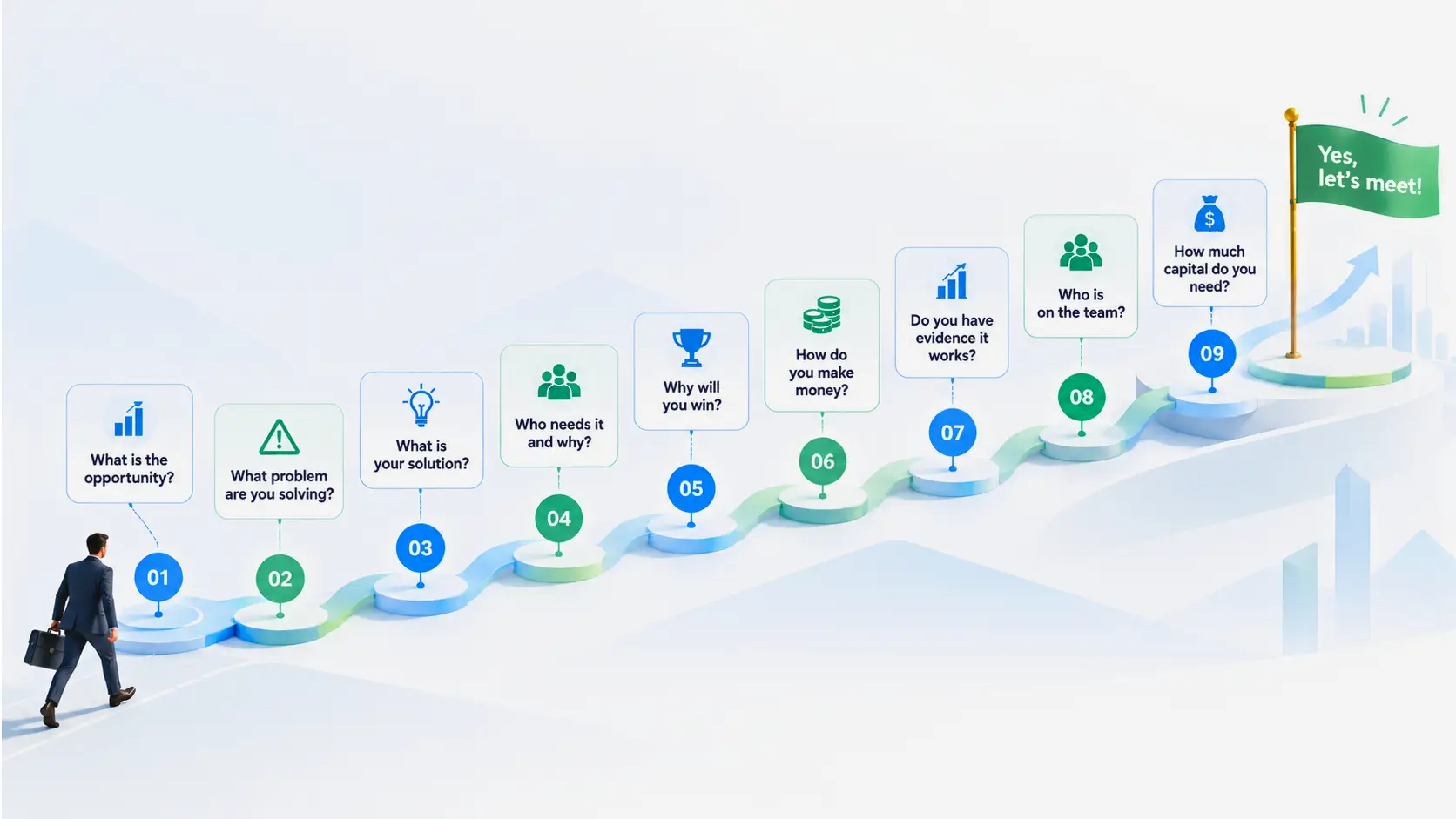
Before you look at each individual slide, keep in mind this rule that every slide should address the investor's next logical question.
The story should progress naturally:
That is the reason why effective decks usually focus on having a clear narrative rather than including a great deal of detail. It is also advised to view the deck as a coherent item to leave behind and therefore making use of graphics, charts, and screenshots instead of having large amounts of text.
The first step is to make your business immediately understandable.
Your opening slide should communicate three things:
You can view this as an elevator pitch presented in visual form. Don't use general remarks like "revolutionizing the future of technology"; instead, describe the real value that you provide.
A good value proposition provides investors with an at once clear mental picture of your business and sets the context for all that comes after.
Make the slide as simple to look at as possible. Generally, you only need your company name, one interesting statement, a brief description, and maybe one striking visual element.
When investors know what you are about, you should clarify who you are and the reason for setting up the company.
Use this slide to briefly introduce:
Instead of sounding like a typical corporate statement, your mission should be linked to the problem you are addressing.
What we want to do is not to go over the whole history of the company; instead, we aim to set the context and build our credibility before discussing the market opportunity.
Great businesses generally start out with a significant problem.
The problem slide must enable investors to grasp what is wrong, identify the parties that are affected by it, and see that the current solutions are not adequate.
There is no reason to bring up a problem just because it seems interesting; instead, show its importance through evidence such as:
A good problem slide generates a sense of urgency and it leaves investors with the thought that "Yes, this is a genuine problem and someone does need to solve it."
The emphasis should be on the customer. You must not let the slide be entirely about your product.
Give your solution to the problem now.
The solution slide must illustrate the way your product or service deals with the pain point that you have just identified. If you can, use product screenshots, diagrams, mockups, a customer journey, or a simple workflow rather than lengthy paragraphs of explanation.
Explain:
Do not turn the slide into a technical manual since investors usually need to know the business value and the way the business is different before asking for all the technical details.
The product ought to be the obvious solution to the problem that was presented on the previous slide.
Just because a solution is excellent does not mean that it represents a good investment; investors must ascertain if the market is large enough to allow for significant growth.
The market opportunity slide needs to identify your target customer and put the size of the opportunity in numerical terms.
Where appropriate, explain:
It would be wrong to inflate your market by just citing a huge figure from a global industry. What investors want is to get a clear understanding of the market that you can actually address.
A small and defensible estimate of the market is usually more convincing than a very large one based on weak assumptions.
The next question is straightforward: what way does the company earn money?
The business model slide needs to explain the mechanism that gives rise to your revenue.
Depending on your company, this could include:
Explain your pricing structure. Where relevant, include important unit economics such as customer acquisition cost (CAC), lifetime value (LTV), average revenue per user, gross margin, or retention.
What we want to do is not to list all the financial figures that you possess; rather, we want to make it clear to investors that your business model is understandable, scalable, and economically viable.
Having a market and a product isn't sufficient; investors also need to understand your plan for acquiring customers.
Your go-to-market slide should answer:
“What is your method of getting your product to reach the people who need it, turning them into customers, and then expanding that process?”
Cover your most important channels, such as:
Provide evidence if you have already picked out the channels that are performing well.
For instance, rather than stating 'We will use digital marketing', you should explain which channel has produced leads or customers, outline the acquisition economics, and describe your plans for scaling it.
Traction turns a good idea into a business, providing evidence for it.
Depending on your stage, traction might include:
It's possible for startups in the early stages to have no substantial revenue at this point. However, that doesn't imply they have nothing to show. Progress can be demonstrated through product adoption, waitlists, customer interviews, pilots, partnerships, or other kinds of validation.
This slide should be used to illustrate both your current position and the key milestones that lie ahead.
A simple timeline is easier to understand than a large number of statistics.
It would be wrong to assume that investors will think you have no competition.
Even though no company provides a product that is exactly the same, customers might still have other methods of dealing with the problem. In this case, competition could come from well-established businesses, start-ups, internal procedures, spreadsheets, external agencies, or even from doing nothing at all.
Your competition slide should answer:
A comparison matrix would be suitable in this case, but it is important to avoid using meaningless checkmarks and to instead highlight the differences that are important to customers.
Your competitive edge might be derived from technology, distribution, network effects, intellectual property, brand, data, cost structure, customer relationships, or operational expertise.
Investors not only put money into businesses but also place their trust in people.
The explanation of the team slide should state the reasons why your team is the one suited to solve this particular problem.
Instead of just giving a list of job titles and degrees, make sure to emphasize your relevant experience, the companies you have worked for, your knowledge in a particular field, your record of entrepreneurship, your technical skills, or any achievements that show your ability to carry out tasks.
For each key person, ask:
“What tangible contribution does this individual make to the company's opportunity for success?”
It is particularly important in the case of companies in the early stages of development, since their future potential might be greater than their past financial performance.
The pitch deck financial slide is one of the parts of an investment presentation that is most closely examined.
Investors should have sufficient information concerning your financial condition, the assumptions about your growth, your capital needs, and your route to achieving sustainable economics.
Depending on your stage, your pitch deck financials slide can include:
For a startup, it may be useful to have three- to five-year projections, but such projections must be based on realistic operating assumptions. Forbes also advises including items like revenue and expense projections, unit economics, burn rate, key business metrics, and the assumptions that underlie the forecast.
Most important of all, don't turn this slide into a spreadsheet.
The reason for including the financials slide is to make the business economics clear, while the detailed financial model can remain in your diligence materials.
In the end, you have to make the request.
State clearly:
For instance, your allocation might be shown in relation to product development, hiring, sales and marketing, infrastructure, or geographic expansion.
What's important is linking capital with activities and milestones.
People should know not only the amount of money you wish to have but also what kind of achievements their capital allows the company to reach.
A statement like "We need 5 million dollars to grow" is much weaker than a clear explanation of the things that the funding will enable.
The last slide must give investors the most compelling reasons to carry on the discussion.
Bring together the core investment thesis:
Now clearly take the next step.
It might be asking for a further meeting, a more in-depth talk about the product, access to the financial model, or a discussion on the funding round.
Provide your contact details and ensure that the investor can get hold of you.
Do not have the last slide just state "Thank You"; your conclusion should highlight the reasons why the opportunity merits attention.
What matters most is the content of your deck, but the design affects how easily investors can take in that content.
The investor presentation design should make it easier, not more difficult, to understand the important information.
Professional design doesn't consist of giving a deck an expensive appearance; it's about minimizing cognitive friction.
The research carried out supports this idea, namely that decks which are a success have advantages from having a clear design since investors have to deal with a large quantity of information over a short time.
A well-organized deck will still fail to make an impression if the execution is poor.
Keep in mind that your deck doesn't have to deal with every question that an investor might possibly ask; it only needs to make the main investment case clear in order to get the following conversation.
A winning investor pitch deck is not the vision, define the problem, demonstrate the opportunity, present the solution, explain the business model, prove traction, show your competitive advantage, introduce the team, validate the financial opportunity, a document that tells investors everything about your company. It is a carefully structured argument for why your company deserves their attention and capital.
The 13-slide framework gives you a strong foundation: establish the vision, define the problem, demonstrate the opportunity, present the solution, explain the business model, prove traction, show your competitive advantage, introduce the team, validate the financial opportunity, and make a clear ask.
The strongest decks also recognize that storytelling and investor presentation design work together. Great numbers need context. A great product needs a market. A large market needs a credible go-to-market strategy. And an ambitious vision needs a team capable of executing it.
Whether you are preparing a seed-round investment pitch deck PPT or a boardroom presentation for investors, the goal remains the same: make the opportunity easy to understand, difficult to dismiss, and compelling enough to continue the conversation.
When every slide has a purpose and every piece of evidence supports the investment thesis, your pitch deck becomes more than a presentation for investors. It becomes a persuasive business case.
As a passionate explorer, I see crafting the perfect story as embarking on a refreshing Himalayan journey. Every narrative is an adventure, a voyage of imagination, meticulously molded into captivating presentations. I'm here to guide you, ensuring your story becomes an unforgettable odyssey, with each creation as a vibrant landscape ready to captivate eager audiences.

About the Author




Consult with our Business Advisor


