

Contact Us
Let’s Partner for Your Next Big Presentation
Consult with our Business Advisor
.webp)


A great PowerPoint presentation is not about adding more information to slides; it is about presenting ideas clearly and effectively. Many presentations fail because slides are overloaded with text, making it harder for audiences to understand the main message. The 2-4-8 Rule in PowerPoint provides a simple way to create cleaner slides by focusing on a clear structure and reducing unnecessary content. It helps presenters highlight key ideas, improve readability, and keep audiences engaged.
In this blog, we will explore how the 2-4-8 Rule works and how you can use it to design more effective PowerPoint presentations.
The 2-4-8 rule in PowerPoint is a simple design guideline that helps you keep slides clean and easy to follow. It says a slide should have no more than 2 main ideas, no more than 4 bullet points, and no more than 8 words per bullet. This keeps the focus on your message instead of a wall of text.
Here's a quick overview:
2 = Max 2 key ideas per slide
4 = Max 4 bullet points per slide
8 = Max 8 words per bullet
In short, it's a constraint that forces clarity.
Slides that follow the 2-4-8 rule are easier for the brain and easier to follow. Here's why:
Your audience's brain can only handle so much information at once. This is often called cognitive load. When a slide is packed with text, the brain has to work harder just to process it. That extra effort distracts from your message and makes it harder for people to remember what you said.
Fewer words and fewer ideas per slide mean less mental effort for your audience. This makes it easier for them to stay focused and follow along.
People cannot read and listen carefully at the same time. When a slide is full of text, most people will start reading it instead of listening to you. This means they miss part of what you're saying while their eyes are stuck on the screen.
A slide with fewer words does the opposite. It gives people just enough to glance at, so they can quickly go back to listening. The slide supports your conversation rather than drawing attention away from it.
This is the main idea behind the 2-4-8 rule. Less text on the slide means more attention on you and your message.
Knowing the rule is one thing. Using it on your own slides is another. Here is a simple process to follow.
Start by asking yourself what the slide is really trying to say. Most slides try to cover too much at once. Pick only the 1 or 2 main ideas that matter most and remove the rest. If something feels important but doesn't fit, save it for your speaker notes or a separate slide.
Once your core ideas are clear, list them out as bullet points. If you have more than 4, look for ones that can be combined or removed. Ask yourself whether each bullet is truly necessary or just extra detail that can be said out loud instead.
Go through each bullet and decrease it to the fewest words possible, ideally 8 or less. Remove filler words like "in order to" or "the fact that." Keep only the words that carry meaning. Short lines are easier to scan and remember.
Need Professional PowerPoint Design?
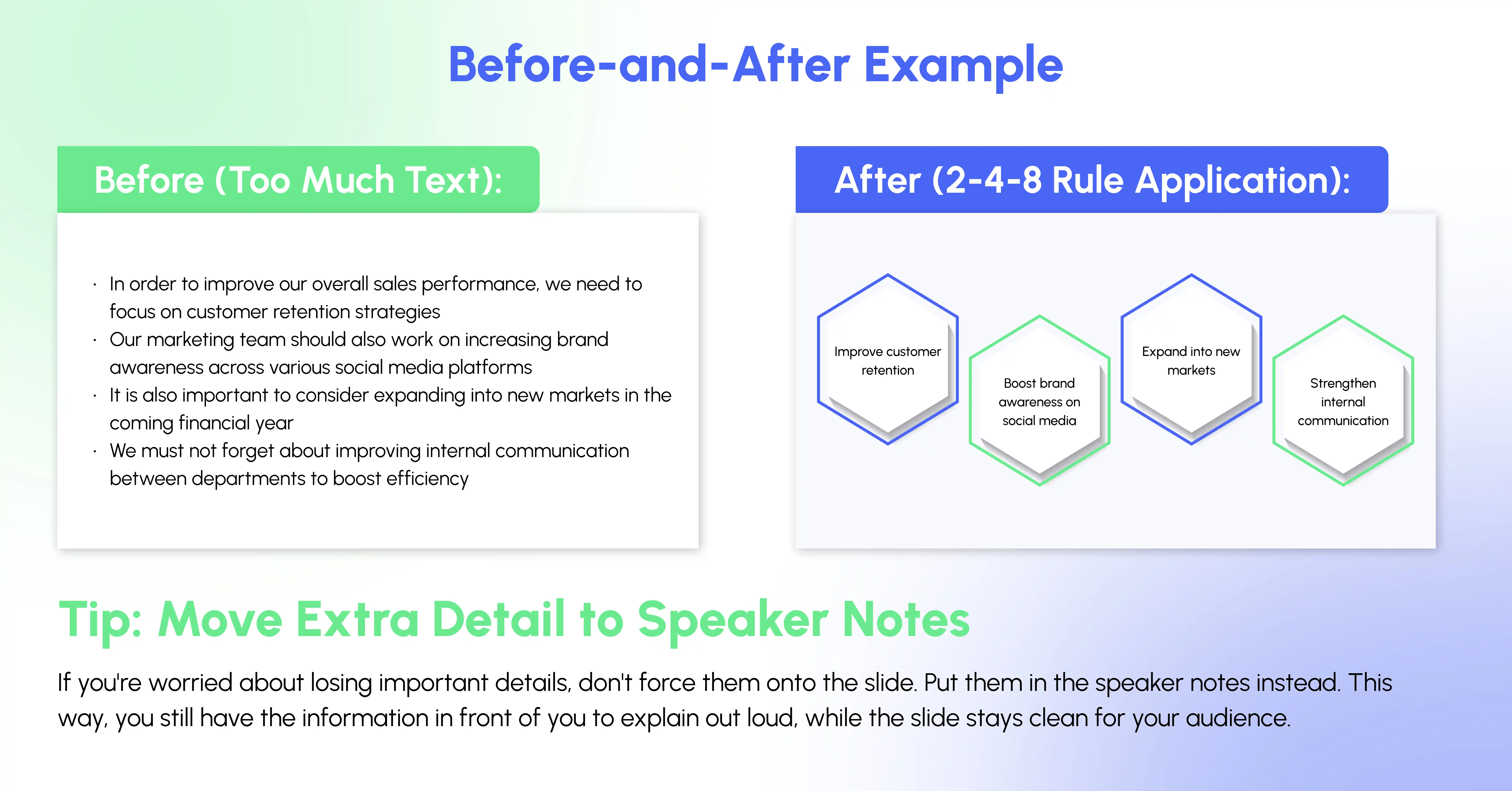
The second version says the same thing in far fewer words. It's easier to read at a glance, which means your audience spends more time listening to you.
If you're worried about losing important details, don't force them onto the slide. Put them in the speaker notes instead. This way, you still have the information in front of you to explain out loud, while the slide stays clean for your audience.
Following a rule the wrong way can cause new problems. Here are a few mistakes to look for.
Run through this checklist before you finalize any slide.
If your slide passes all six checks, it's following the 2-4-8 rule.
Great slides don't win attention by saying more. They win it by saying less, and saying it clearly. The 2-4-8 rule gives you a simple way to do that: 2 ideas, 4 bullets, 8 words per line. It's easy to remember and even easier to apply.
Start small. Pick your next deck, run it through the checklist, and see how much stronger it feels with fewer words and cleaner slides. Once it becomes a habit, you'll find yourself building better presentations without even thinking about the rule.
If you want your next deck to look as sharp as it sounds, you don't have to do it alone. INK PPT, the presentation design agency, specializes in turning messy, text-heavy slides into clean, professional presentations that follow proven design principles, so you can walk into any meeting with confidence.
As a passionate explorer, I see crafting the perfect story as embarking on a refreshing Himalayan journey. Every narrative is an adventure, a voyage of imagination, meticulously molded into captivating presentations. I'm here to guide you, ensuring your story becomes an unforgettable odyssey, with each creation as a vibrant landscape ready to captivate eager audiences.

About the Author




Consult with our Business Advisor


