
Contact Us
Let’s Partner for Your Next Big Presentation
Consult with our Business Advisor
.webp)
Thank you! Your submission has been received!
Oops! Something went wrong while submitting the form.


In the context of business marketing, visuals are no longer simply supporting information. They are, in many cases, the primary vehicle of information. Whether it is a product announcement, a sales pitch, a platform tour, or a brand film, the way information is visualized has a direct impact on how quickly it can be digested, how seriously it can be considered, and how confidently it can be acted upon.
Among all these, animation has emerged as one of the most powerful tools for simplifying complexity, shaping perception, and delivering marketing results. However, in the process of growing in popularity, there has been a lot of confusion around the different types of animation. Perhaps the most common questions that marketers struggle to answer today are whether they should use 2D or 3D animation and why.
Is 2D animation better than 3D animation, or vice versa, when it comes to the advantages and disadvantages of each type of animation in the context of business marketing? This article will discuss the advantages and disadvantages of 2D and 3D animations specifically in the context of business marketing. Animation, as a tool of business communication, and not simply a form of creative expression, will be discussed.
The assumption that animation is a design decision may be one of the most expensive misconceptions in enterprise communication. Animation drives the manner in which information is processed, the speed at which meaning is extracted, and the degree of confidence with which stakeholders react. This, in a business decision, selects 2D vs 3D animation, a decision with business implications.
In weighing the 2D vs 3D Animation Advantages and Disadvantages, business leadership forces itself to think about the manner in which business leaders consume information. They are under pressure of time and information glut, and animation should simplify thought, not demonstrate technical prowess.
Senior stakeholders engage only when value is communicated quickly. An animation that delays meaning in favor of visual sophistication often loses attention before the message lands.
Complex business models, platforms, and services already require mental effort. When complex visuals are layered on top, comprehension declines. Animation should reduce cognitive friction, not amplify it.
Shorter sales cycles require speed and clarity. Longer enterprise sales cycles may justify realism, but only when it directly supports evaluation, risk mitigation, or internal alignment.
Enterprise decisions involve multiple stakeholders. Technical teams require accuracy and structure. Executives require clarity and prioritization. Animation must accommodate both perspectives.
Enterprise communication evolves. Animation styles that are difficult to update become operational liabilities.
Animation works only when it reduces friction in decision-making. Any format that adds friction, regardless of visual quality, is strategically misaligned.
2D Animation means animated graphics that are created on a flat plane that exists only in 2 dimensions. In other words, height and width exist but depth does not. Characters, icons, graphics, etc., move across a screen to describe a concept.
2D Animation has many uses in business marketing because it focuses on clarity rather than complexity. It does not try to mirror real-world graphics but instead uses storytelling, symbolism, etc., as a means of communication.
Some uses of 2D Animation that businesses might use as part of their marketing strategy are:
The real strength of 2D Animation as a marketing tool comes from its ability to communicate ideas quickly. 2D Animation strips away visual clutter that might distract from a message. In many situations, this clarity will prove a significant marketing advantage.
In considering the 2D Animation vs 3D Animation advantages and disadvantages, 2D Animation often proves a clear winner.
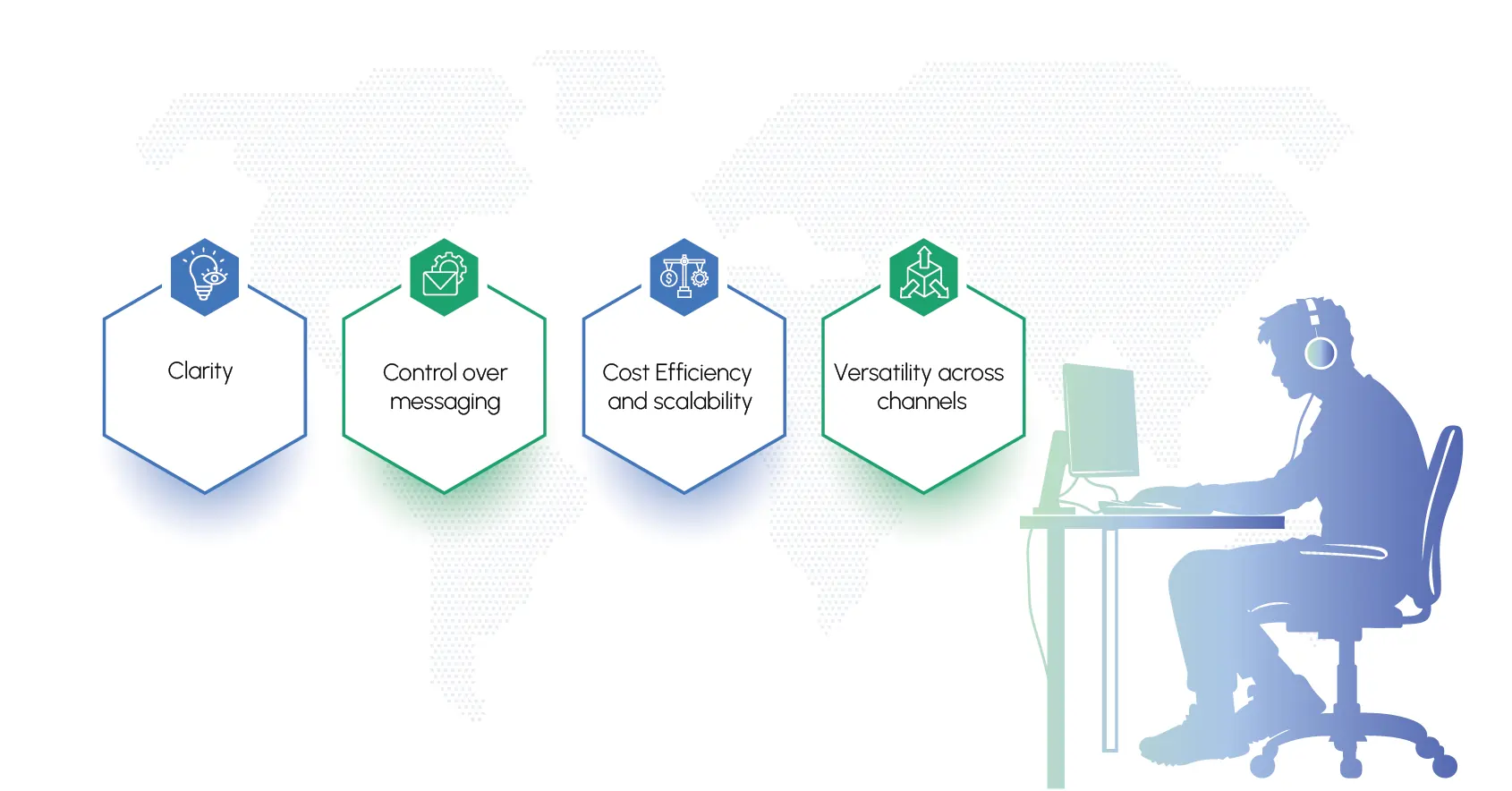
2D animation shines when businesses require speed, clarity, and scalability in communication that does not overwhelm their audiences or increase costs.
The strongest attribute that 2D animation has over other animation types is speed. Since 2D animation involves simple graphics, it can be easily understood by the target audience. This attribute is extremely important when creating marketing animation for businesses with limited attention span.
2D animation allows marketers to:
These advantages make 2D animation extremely important for marketers when it comes to explainer videos and awareness-stage marketing.
In 2D animation, every visual element is deliberately designed. There are no accidental details. This gives marketing teams complete control over what the audience sees, focuses on, and remembers.
This makes 2D animation ideal for:
The message is never overshadowed by visual complexity.
From a production standpoint, 2D animation is generally more cost-effective than 3D. It requires fewer technical resources, shorter production timelines, and simpler revision cycles.
For business marketing, this translates into:
For organisations running ongoing campaigns or large content ecosystems, this scalability is a major advantage.
2D animation adapts easily to multiple formats, such as, such as social media, presentations, websites, internal communications, and training modules. Assets can be reused, repurposed, and resized without losing clarity or quality.
This versatility makes 2D animation a reliable foundation for long-term animation strategies in business marketing.
While 2D animation offers strong advantages, it also has limitations that must be considered.
Since 2D animation is abstract in nature, it is not capable of mimicking physical realism. For businesses that require physical quality, size, and detail to be important factors in defining value perception, this would be a limitation. For businesses that require physical demonstrations of how something works in real life, 2D animation would not be as effective.
In high-stakes marketing situations, 2D animation would not be as impactful in situations that require investor pitches or premium value demonstrations. Although 2D animation excels in this field by being able to explain complex ideas in simple terms, there are certain situations where weight and engineering are important.
In a situation where products are expected to evoke emotions, 2D animation may not be able to evoke the same level of emotion as 3D animation, especially in products that are physically interactive.
With 3D animation, there is depth, volume, lighting, texture, and perspective. There are objects in three-dimensional space, allowing people to see products in different ways and understand what is inside the object.
In terms of 3D animation in business marketing, this type of animation is used when realism and proof are more important than abstraction. 3D animation does not require people to be told what something does; instead, 3D animation shows what something does.
Common business applications of 3D animation include:
Unlike 2D animation, which focuses mainly on storytelling, 3D animation focuses mainly on credibility. 3D animation has the power to show people what something looks like. In terms of 2D and 3D animation advantages and disadvantages, 3D animation excels in terms of realism and value for businesses that deal in physical products.
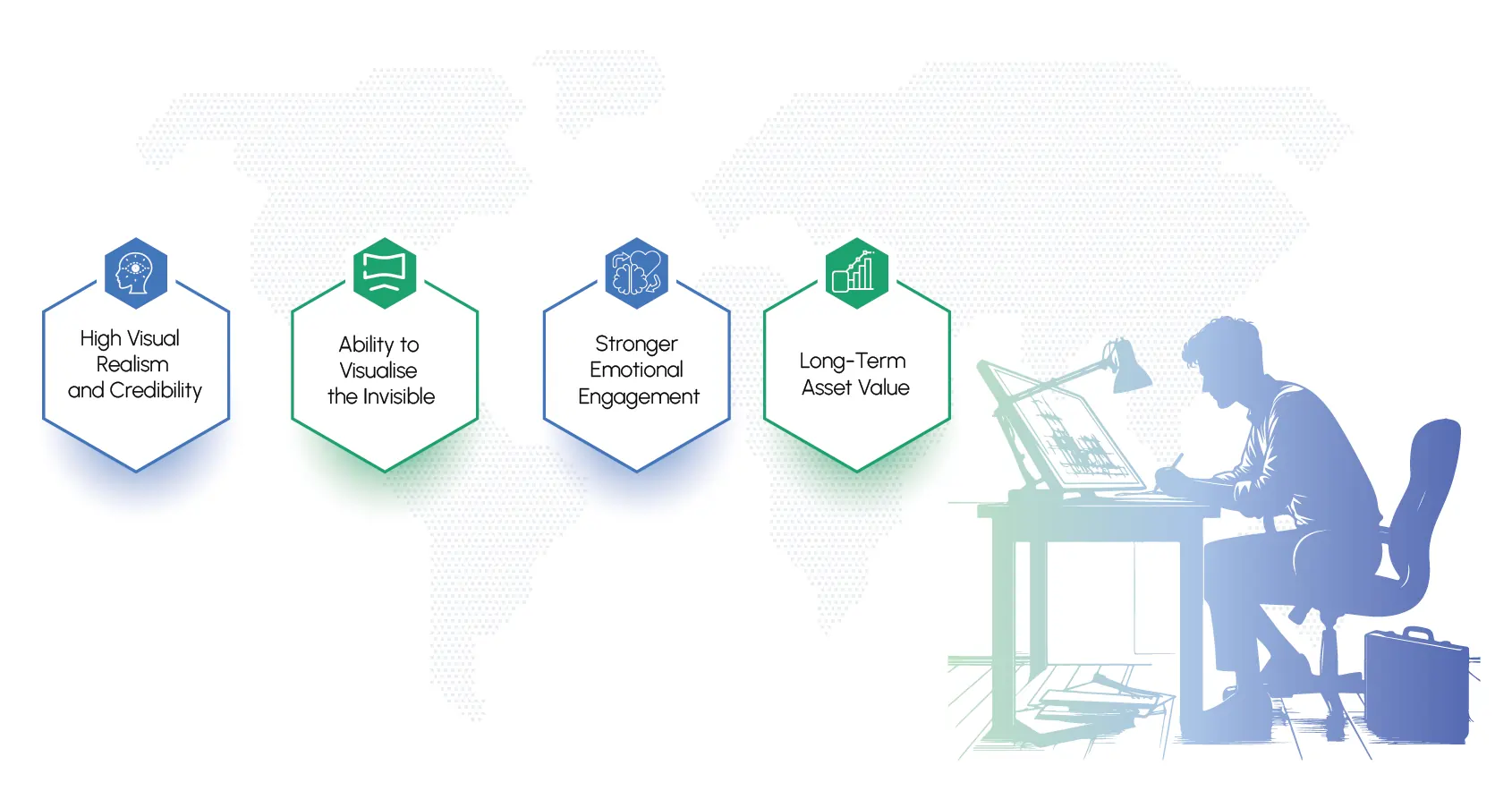
3D animation adds realism and visual depth, making it especially effective for showcasing complex products, environments, and technical functionality with credibility.
One of the most significant advantages of 3D animation is realism. Products can be shown with precise dimensions, materials, lighting, and movement. This realism builds trust, especially when audiences are evaluating quality, performance, or feasibility.
For business marketing, this is invaluable in:
3D animation allows marketers to reveal what cannot be seen with the naked eye, internal mechanisms, data flows, structural components, or future concepts.
This capability is particularly powerful in:
It turns abstract or hidden complexity into tangible understanding.
The cinematic quality of movement, lighting, and cameras in 3D animation can lead to a strong emotional engagement. This can be beneficial for the brand in terms of perception. For high-end offerings, the decision to buy can be influenced significantly by the emotional engagement.
The quality of assets developed in 3D animation can be useful for a long time. Assets developed can be reused for different marketing needs. This makes it a long-term investment. INK PPT also provides the option of developing assets compatible with Unity, Unreal Engine, WebAR, and mobile AR.
Despite its visual impact, 3D animation demands higher investment, longer production timelines, and careful planning to justify its complexity in business contexts.
The production of a 3D animation demands skills, expertise, and software. It takes a long time to produce a 3D animation. It can be a problem for marketing teams who are working with a tight budget.
There is a great risk of overemphasizing the visual aspect of the message. It can lead to the production of a video that has great visual appeal but does not convey the message in an appropriate manner. Realism can be a distraction if it is not properly directed.
In the case of ideas, processes, or platforms, the production of a 3D animation can be a disadvantage. It is because the advantages of a 3D animation are not greater than the disadvantages.
For INK PPT, the decision on animations is not about following trends but about communication goals and objectives. For projects requiring clarity, speed, and consistency, 2D animation is used for applications such as explainer videos, walkthroughs for SaaS and platforms, internal communications, training content, and even idea-driven storytelling for brands. The emphasis is on structured storytelling for easy understanding and interpretation of complex information.
For clients such as Raychem, where technical accuracy and realism were essential, 3D animation was deployed to showcase product design and functionality. Deliverables included:
Through the strategic use of 2D and 3D animations, INK PPT is able to deliver projects that not only offer clarity and visualization but also usability and credibility for the future, overcoming the limitations of 2D and 3D animation for practical business use cases.
Ready to bring your ideas to life with strategic animation? Get in Touch with us to see how 2D and 3D animation can elevate your business communication.
The importance of understanding the 2D vs 3D Animation Advantages and Disadvantages is not just about the look and feel. It is about the way your audience thinks, processes, and makes decisions. For the decision-makers in the enterprise, who are trying to make high-stakes decisions about the way they communicate with their audience for critical business needs like investor relations, product launches, sales enablement, or brand positioning, the difference between 2D vs 3D animation has a direct impact on the decision process.
For the enterprise, 2D animation provides speed, clarity, control, and scalability. It is the best choice for messaging that needs to be consumed quickly and efficiently. For the enterprise, 3D animation provides realism, immersion, emotion, and prestige. It needs to be managed within a framework of discipline, control, and strategic intent.
At INK PPT, we partner with enterprise teams to translate business strategy into visual communication that drives outcomes. We do not choose between 2D and 3D simply on visual appeal. We choose based on impact, clarity, cognitive alignment, and decision acceleration.
If you are an enterprise that needs animation that aligns with your strategy, builds credibility, and accelerates the decision process, INK PPT can help you make the decision, not just the animation.
As a passionate explorer, I see crafting the perfect story as embarking on a refreshing Himalayan journey. Every narrative is an adventure, a voyage of imagination, meticulously molded into captivating presentations. I'm here to guide you, ensuring your story becomes an unforgettable odyssey, with each creation as a vibrant landscape ready to captivate eager audiences.

About the Author



.webp)
Consult with our Business Advisor


