
Contact Us
Let’s Partner for Your Next Big Presentation
Consult with our Business Advisor
.webp)
Thank you! Your submission has been received!
Oops! Something went wrong while submitting the form.


Every marketing decision ultimately comes down to one question.
How quickly does the audience understand what is being communicated?
And how accurately do they interpret its value?
That understanding is shaped less by text and more by motion, structure, and visual clarity. This is why animation has become a strategic communication asset rather than a creative add-on. The choice between 2D vs 3D Animation for Business directly affects how ideas are processed, how products are perceived, and how effectively messages drive outcomes.
Different formats influence attention and trust in different ways. 2d animation for business marketing supports clarity by simplifying complex narratives, while 3d animation for business promotion builds credibility through realism and depth.
For brands focused on animation for business growth, this decision is no longer stylistic. It is about aligning visual execution with real business use cases for animation and creating consistent animation for brand communication that delivers measurable results.
Before discussing various formats, a definition of animation and what animation actually does in a business environment must be clarified.
The animation in marketing is not meant for entertainment purposes. It is meant for a specific, structural reason. The best-case scenario for animation is being a clarifier of intent, ensuring there is no misunderstanding in the way things are being processed.
In practical terms, animation supports business communication by:
When these results are achieved, animation will become a catalyst for animation for the purposes of brand communication rather than content creation per se. Both 2D and 3D formats can help achieve this objective. The main point of contention is the manner in which each handles attention, complexity, and perception.
When it comes to the realm of business marketing, the 2d animation for the purpose of marketing is more about the intentions of drawing the focus. The utilization of 2D animation is based on the use of motion graphics, text, icons, texture, and simplified graphics.
At INK PPT, 2D animation is a form of storytelling. The static images come alive through motion, pacing, and storytelling to communicate processes, the benefit of products, or an idea. The key is always clarity – using motion to lead the viewer through ideas rather than bogging them down.
Since it values logic over reality, 2D animation is most suited when the marketing goal is understanding rather than engagement. It is most effective when brands have to communicate systems, platforms, and processes where structuring is given more significance over depth.
From the viewpoint of strategies, the best applications of the 2D animation process are:
This is why service-led, platform-driven, and idea-centric businesses use 2D animation as a core layer of animation for brand communication.
In realistic applications of business, 2D animation offers the greatest value in these areas:
Removing visual intricacies, the main advantage of 2d animation for business marketing is that viewers are able to concentrate more on comprehension than interpretation, which is very important for fast-paced situations where information is paramount.
In respect to performance: 2D Animation:
Organizations that emphasize scaled clarity, therefore, find 2D animation a reliable animation platform for business expansion, especially under education-driven and awareness-phase marketing.
With 3D animation, the consideration of depth, lighting, texture, and space is added to the narrative. Brands can demonstrate, rather than explain, the product or the system through 3D animation. When it comes to 3d animation for promotional purposes, reality is more of a means to the end than it is for aesthetics.
INK PPT’s 3D work has been built on the foundations of cinematic product storytelling. Products are shown the same level of attention as is paid in a motion picture. Design details are shown with the same level of attention as dynamic perspectives, while details are shown in a story-based motion presentation.
While 2D develops concepts, 3D animation for business purposes illustrates reality.
In order to properly grasp the effects of realism, depth, and motion on perception, it would be beneficial to examine the application of 3D animation in regard to an actual marketing scenario.
The below automotive showreel serves as an example of how 3D animation can add value to the storytelling of products, engineering detail, and the perception of premium brand automobile companies through the element of motion.
3D animation is most valuable in business applications involving animation, when credibility and proof are most important:
Additionally, INK PPT produces AR/VR-ready 3D assets, lightweight, photoreal models for platforms such as Unity, Unreal Engine, WebAR, and mobile AR, so brands can take the storytelling experience from the 2D space into the interactive realm of AR/VR environments.
From a results perspective, 3D Animation:
For complex or high-value products, 3D animation will become a direct enabler of animation for business growth, especially when marketing results are based on trust, clarity, and conviction.
In situations where confidence is built on what can be seen rather than what is said, the importance of 3D animation cannot be overstated. This is where INK PPT helps by producing cinematic, photo-real animations.
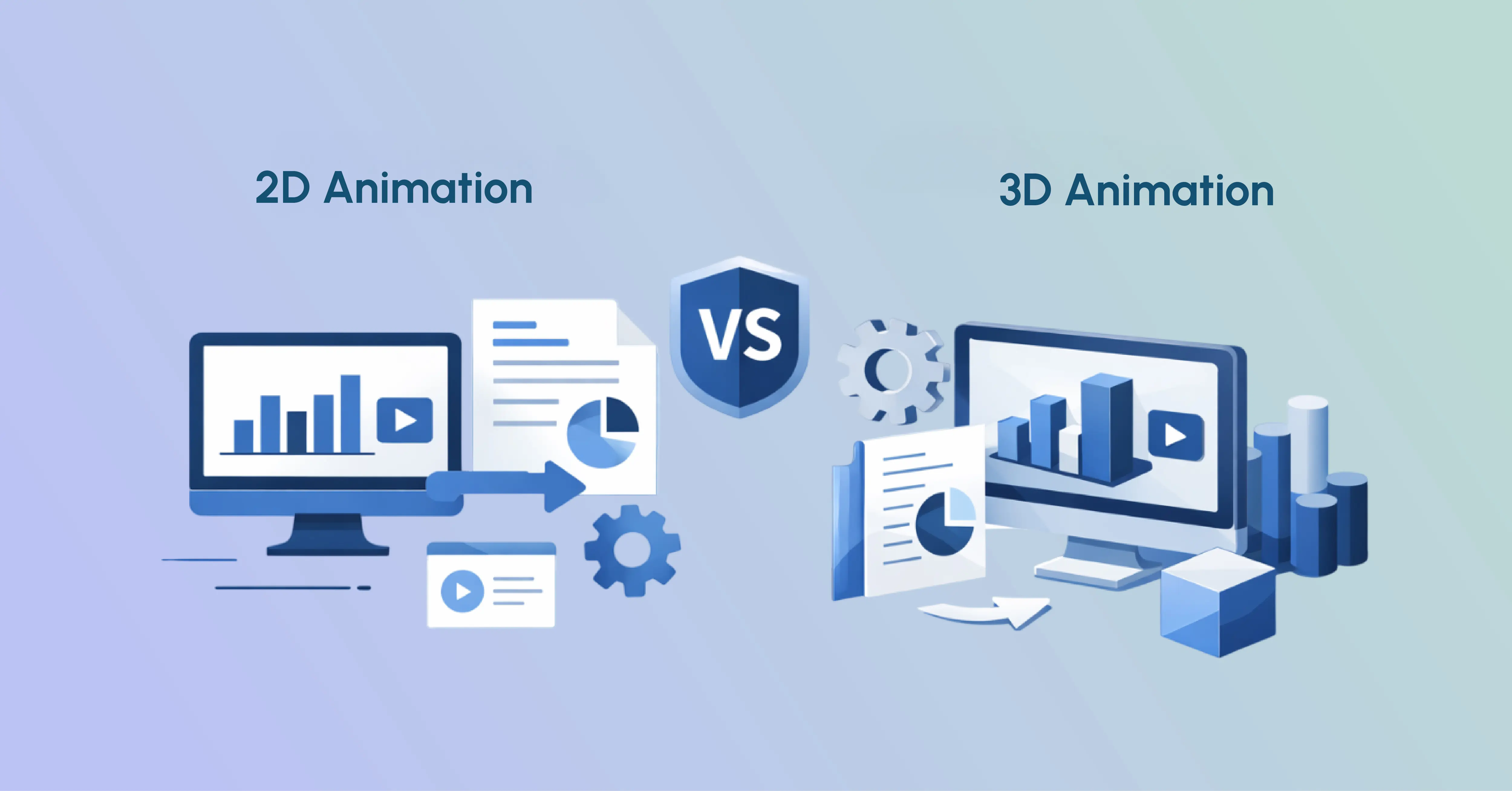
A comparison of 2D and 3D animation strengths across communication speed, realism, product storytelling, and long-term marketing asset value.
The takeaway is simple: 2D drives understanding, 3D builds belief, and business impact comes from choosing accordingly.
INK PPT uses the art of animation in understanding, perception, and decision-making as a decorator of marketing communication. All our 2D and 3D animations are designed for one business purpose: Clarity, Credibility, or Conversion.
Before production, we establish the storyworld that needs to be created for the brand and the journey the audience needs to take from first impression to understanding. This ensures that animation is developed for a narrative, not a series of features. This foundation is applied to both 2D and 3D executions.
We apply 2D animation and motion graphics when there is a need for clarity at scale. We use choreographed motion, animated type, and simplified systems to communicate complicated concepts in an easily understandable and uninterrupted way.
The result is consistent animation for brand communication across teams and markets.
We deploy 3D animation when proof and perception matter. Photoreal visuals and cinematic motion help products and systems feel tangible in launches, technical storytelling, and high-stakes conversations.
This becomes especially critical in technical categories, where clarity directly influences confidence. In the Raychem project, this approach was applied by structuring complex product information through isometric visuals, a 360-degree interactive view, and a focused application animation. Instead of relying on verbal explanation, functionality was communicated visually, allowing stakeholders to understand, evaluate, and trust the product with greater certainty.
With the rising trend of enterprise communication becoming more visual and decision-oriented, the decision between 2D vs 3D Animation for Business is no longer a creative preference for us–it’s a decision. Here is where we recognize the strength of 2d animation for business marketing. Here is where we recognize the strength of 3d animation for business promotion.
We at INK PPT create the design for the animation infrastructure of animation for brand communication purposes, and not for stand-alone content on animation. Our design strategies are based on real business needs for the application of animation, where every design element enhances comprehension, followed by confidence. Animation used properly becomes an effective force behind business animation, not just for communication purposes.
If your marketing is driven by the need for clarity, the need for credibility, or the need for high-stakes decision-making, animation should be integrated into your story, not tacked on at the end.
As a passionate explorer, I see crafting the perfect story as embarking on a refreshing Himalayan journey. Every narrative is an adventure, a voyage of imagination, meticulously molded into captivating presentations. I'm here to guide you, ensuring your story becomes an unforgettable odyssey, with each creation as a vibrant landscape ready to captivate eager audiences.

About the Author



Consult with our Business Advisor


